
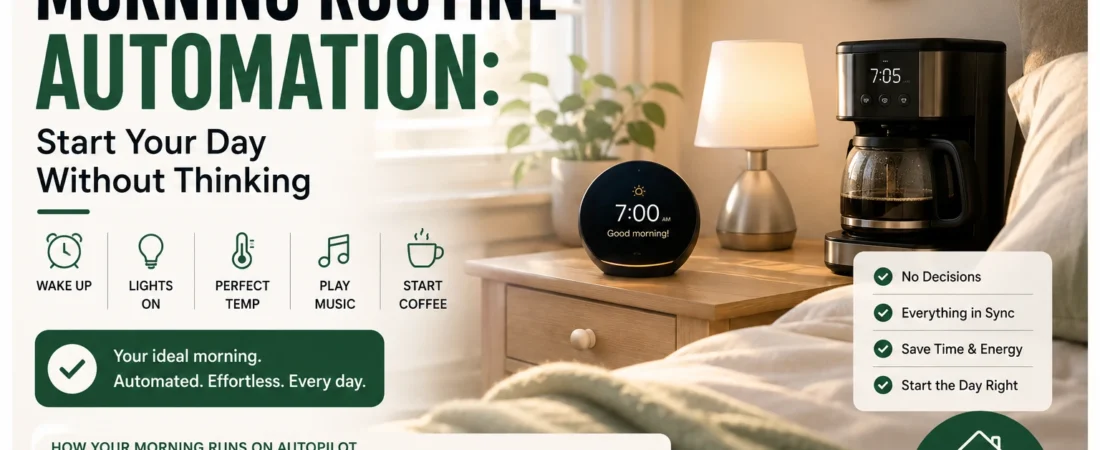
How to Automate Your Morning Routine: A No-Decision System for Busy People
The average adult makes 35,000 decisions per day, and willpower is highest in the morning. Here’s how to protect it.
The average adult makes approximately 35,000 decisions per day (CNBC, 2025, retrieved May 2026). A large share of those happen before you leave the house. What to wear. Whether to make coffee or skip it. Did you lock the door. Is it warm enough to turn off the heat.
That’s not a discipline problem. It’s a design problem. Morning routine automation solves it by removing those choices from your day entirely. What would your morning look like if most of those decisions were already made?
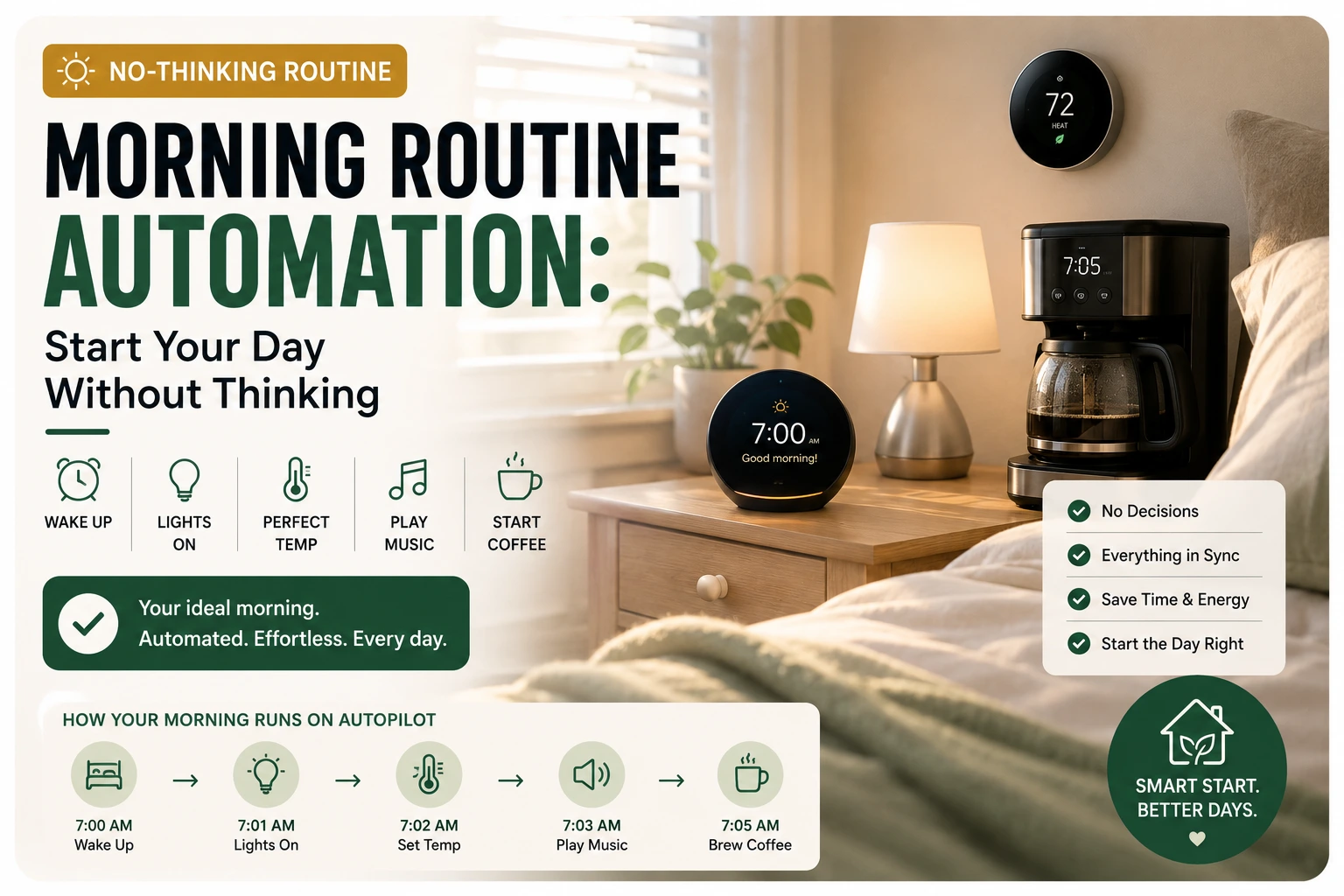
A properly automated morning runs on a schedule you set once. The coffee brews before you’re out of bed. The temperature adjusts before your alarm sounds. The floor gets cleaned during your shower. None of it requires an app, a voice command, or a decision.
This guide covers exactly which morning routine automation steps to set up, in what order, and how to get it done in one evening.
What You Need to Know
- The average adult makes 35,000 decisions per day, with cognitive performance at its highest in the morning (CNBC, 2025, retrieved May 2026).
- 44% of people with a morning routine prepare the night before, and 2 in 3 of those report lower daily stress (ThrivemyWay, 2024, retrieved May 2026).
- Five devices cover a complete morning routine automation: smart plug, thermostat, smart bulb, robot vacuum, and smart lock.
- A smart plug on your coffee maker takes under 10 minutes to set up and costs $10–$20.
- The goal is zero daily app interaction , everything runs on schedule, not on command.
Why Does Your Morning Feel Like Work Before Work Has Started?
Cornell University researchers estimate people make around 200 decisions per day on food alone (Cornell University, 2006, retrieved May 2026). Add clothing choices, temperature adjustments, device checks, and the mental list of things you might have left on. You’ve already spent real cognitive resources before leaving the house.
Decision fatigue shows up clearly in high-stakes settings. A landmark study published in the Proceedings of the National Academy of Sciences found judges granted parole 70% of the time in morning sessions and less than 10% in late afternoon , with no other variable changing (Danziger et al., 2011, retrieved May 2026). The same cognitive drain happens in every household every morning.
Most morning routines fail not because people lack motivation. They fail because they’re built on active choices rather than automatic systems. Every “what should I do next?” is a small withdrawal from the same decision budget. The fix isn’t a better habit. Morning routine automation removes those decisions entirely.
What Does a No-Decision Morning Actually Look Like?
Morning routine automation means everything that can run on a schedule already does. Your bedroom temperature rises before your alarm. Coffee is already brewing when you walk into the kitchen. The floor was cleaned during your shower. The door locks when you leave without you touching anything.
The key distinction is scheduled automations versus manual triggers. If starting your morning routine requires saying “Alexa, start my morning” or tapping a scene in an app, you’ve added friction instead of removing it. A voice command is still a decision. The goal is a home that starts your day without being asked.
According to SQ Magazine’s 2025 smart home survey, 41% of smart home users engage in routine-based automation such as scheduled morning wake-ups (SQ Magazine, 2025, retrieved May 2026). That share has climbed steadily as Wi-Fi-native devices have made setup faster and cheaper.
Among people with a consistent morning routine, 44% prepare the night before, and 2 in 3 of those report lower daily stress (ThrivemyWay, 2024, retrieved May 2026). Scheduling automations in advance is the digital version of laying out your clothes the night before, except it scales across your entire home.
The full system behind a zero-friction home is covered in the lazy-proof home organization and automation system. This guide focuses specifically on the morning routine automation layer.
What Are the 5 Automations That Cover a Complete Morning?
| Automation | Device | Cost | Setup Time |
|---|---|---|---|
| Coffee maker on timer | Smart plug | $10–$20 | < 10 min |
| Temperature pre-wake adjust | Smart thermostat | $150–$250 | 45–60 min |
| Sunrise wake-up light | Smart bulb | $15–$40 | 5–10 min |
| Floor cleaning during shower | Robot vacuum | $150–$250 | 20–30 min |
| Auto-lock on departure | Smart lock | $170–$230 | 45 min |
1. Smart Plug on Coffee Maker ($10–$20)
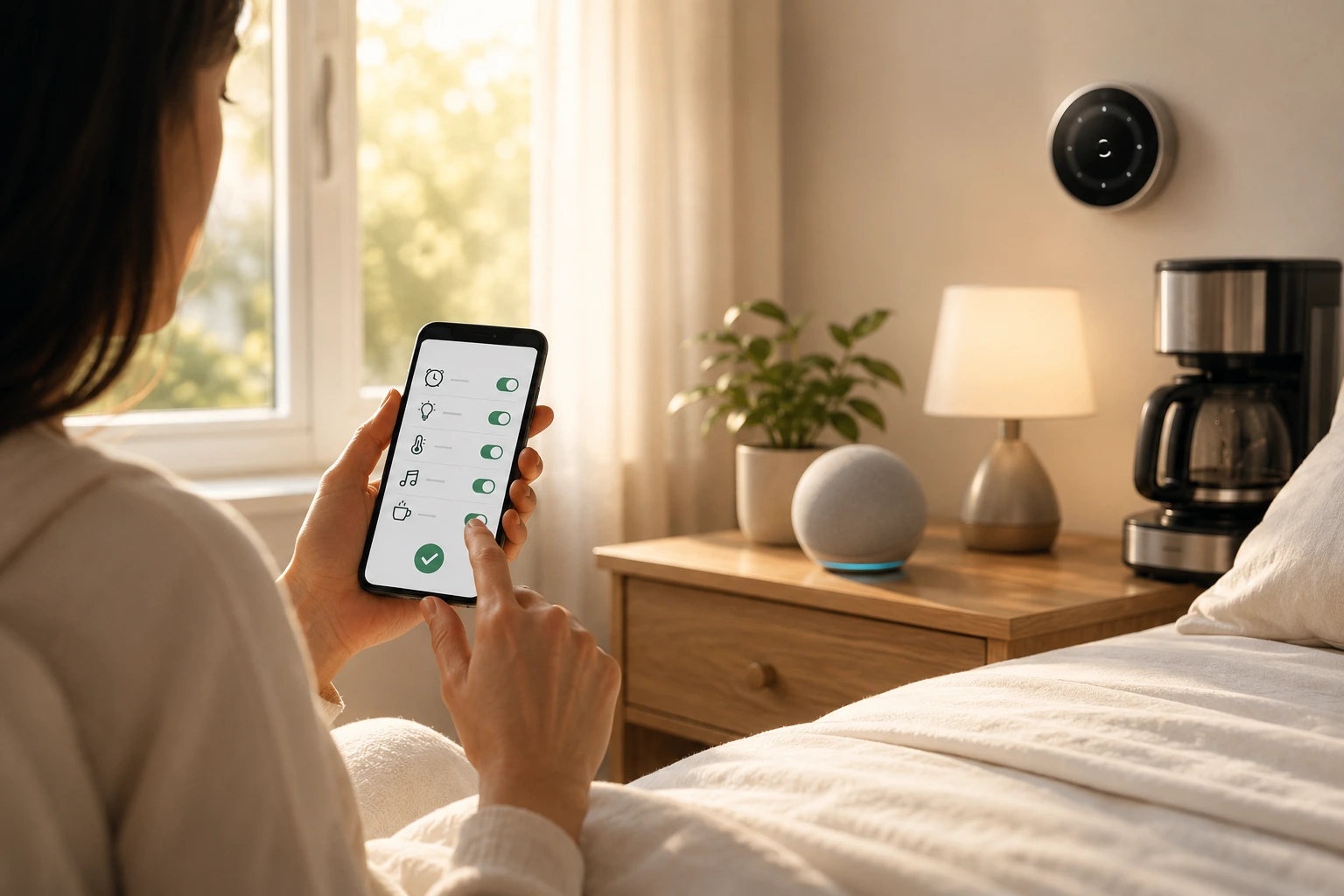
A standard drip coffee maker plugged into a Kasa Smart Plug Mini brews at a scheduled time with zero app interaction. Set the schedule once. The coffee maker does the rest.
This replaces the decision to start brewing, the wait after waking up, and the daily “did I leave it on?” check. For $10–$20, this is the highest-ROI smart home purchase for morning routines. Use it with any coffee maker that has a manual toggle. The smart plug supplies power on schedule and the machine brews automatically when it gets power.
Setup time: under 10 minutes from unboxing to a live schedule.
2. Smart Thermostat Morning Schedule ($150–$250)
An Ecobee Smart Thermostat Premium or Nest can raise your bedroom temperature from its overnight cool-down setting 20–30 minutes before your alarm. Waking up at the right temperature, not too cold and not stuffy, makes the physical act of getting out of bed less unpleasant.
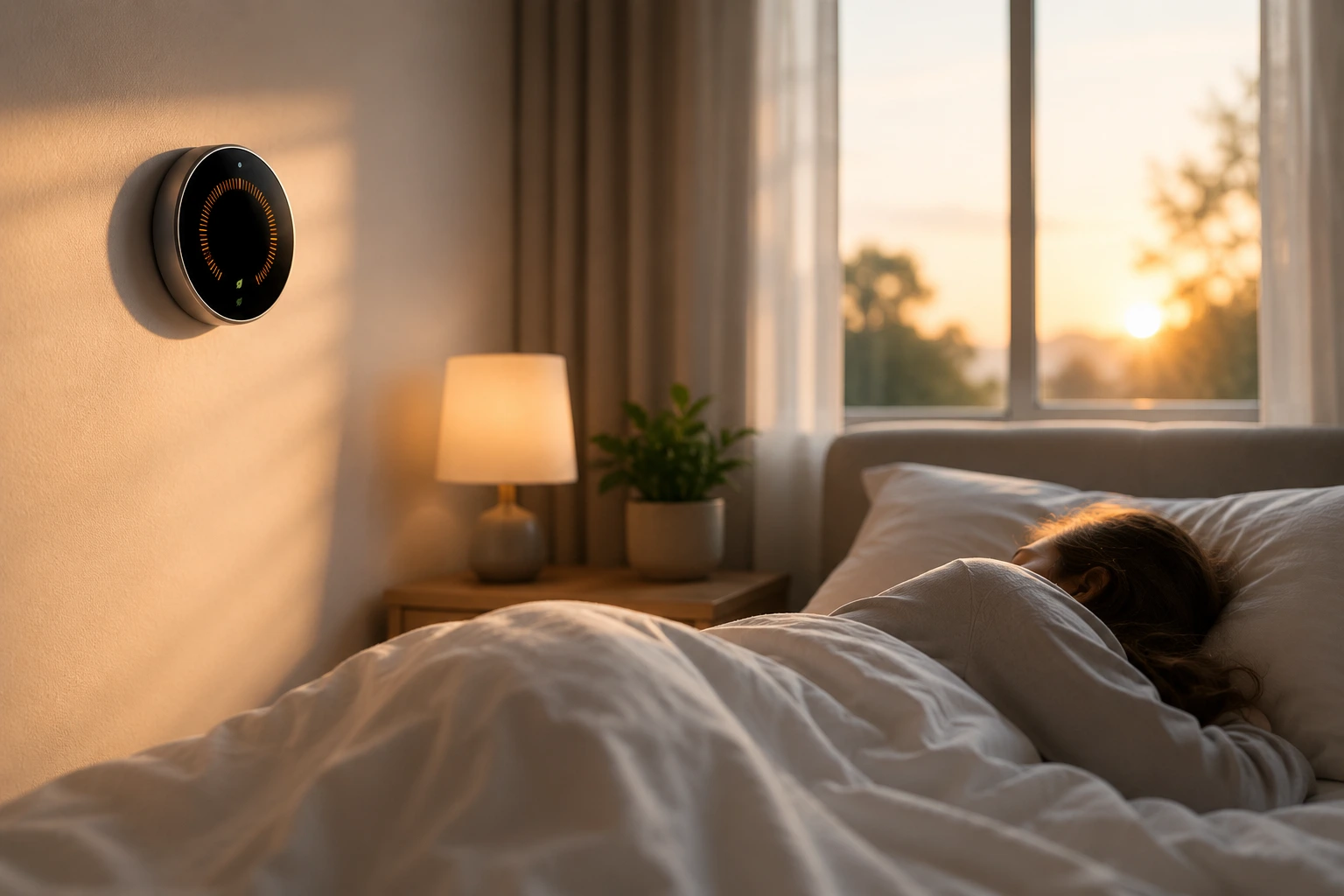
The EPA Energy Star program independently verifies an average 8% saving on HVAC costs per year (EPA Energy Star, 2024, retrieved May 2026), with Ecobee’s own energy analysis showing users saving up to 23% over standard thermostats. Setup takes 45–60 minutes once. After that: zero interaction. It adjusts automatically when you leave for work.
This device also handles the morning check of “did I leave the heat running?” Because you didn’t. The schedule turned it down when your phone’s geofence registered your departure.
3. Smart Lighting Wake-Up ($15–$40 per bulb)
A smart bulb (Philips Hue, LIFX, or Wyze), programmed to gradually brighten from 0% to 70% over 30 minutes before your alarm simulates sunrise. This signals your body’s circadian system to reduce melatonin production before the alarm sounds.
The practical result: you wake up less groggy because your body has already started the waking process. One bedroom smart bulb handles this. You don’t need a whole-house lighting system , that adds complexity faster than it removes friction. For a clear breakdown of where smart lighting earns its place versus where it becomes clutter, see the minimalist smart home guide.
4. Robot Vacuum During Shower ($150–$250)
Schedule your robot vacuum to run during your morning shower. The floor is clean when you’re done, and you made zero decisions to get there.
Americans spend 56 minutes per week on floor cleaning (ACI/RMS Cleaning, 2025, retrieved May 2026). A robot vacuum scheduled for the 10–15 minutes you’re already in the shower reclaims most of that time passively. The MOVA S10 (~$169–$249) handles most homes well. For smaller spaces, the Eufy RoboVac 11S Max (~$150–$200) is simpler and quieter. Full details in the cleaning automation beginner’s guide.
5. Smart Lock Auto-Lock ($170–$230)
Configure your front door smart lock to lock automatically when all phones leave the home’s geofence. Or set a fixed departure lock schedule.
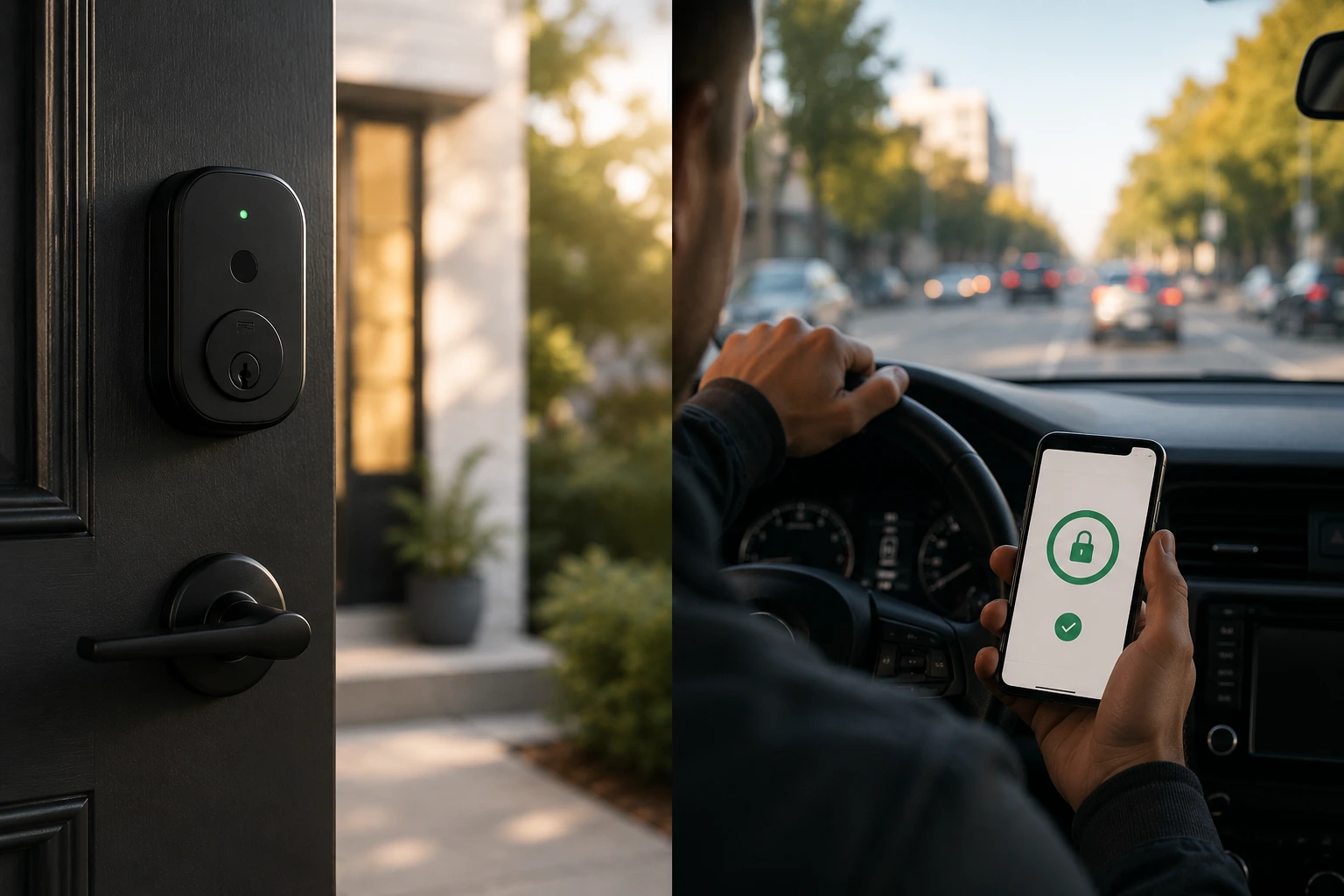
What this removes from your morning: the “did I lock the door?” question that interrupts your commute. That moment of uncertainty (sometimes it means turning around mid-commute just to check) is a genuine time and attention cost. The Schlage Encode Smart WiFi Deadbolt connects directly to Wi-Fi with no hub needed. Setup takes about 45 minutes. After that, you stop thinking about door locks entirely.
How Do You Build This in One Evening?
How long does this actually take? Less than one weekend, in five steps.
Step 1: Smart plug on coffee maker (under 10 minutes). Download the Kasa app, plug the Kasa Smart Plug Mini into the outlet behind your coffee maker, connect to Wi-Fi, and set a 6:30 AM schedule. That’s the entire setup. It’s the fastest proof that automation works.
Step 2: Smart thermostat (45–60 minutes). Do this on a Saturday when you’re not rushed. Turn off the HVAC breaker, swap the old thermostat, follow the manufacturer wiring guide , most thermostats support standard 5-wire systems. Set a morning pre-heat schedule once, and it runs forever.
Step 3: Smart lighting (5–10 minutes). Replace the bulb in your bedside lamp or bedroom overhead fixture with a smart bulb. Set a gradual brightness schedule starting 30 minutes before your usual alarm. One bulb, one schedule.
Step 4: Robot vacuum (20–30 minutes). If you already have one, set a daily schedule for shower time via the app. If you’re buying one now, the first mapping run usually takes 30 minutes and generates a full floor plan. After that, it runs on schedule with no further input.
Step 5: Smart lock (45 minutes, do this last). Add this after the other four are running invisibly. The adjustment period , getting comfortable without a physical key , takes about a week. Give yourself that window before fully committing.
Total weekend time investment: 3–4 hours. After two weeks, the morning routine automation system is invisible. You stop noticing the individual devices and start noticing that your mornings feel different.
What Should You Automate First?
ThrivemyWay’s 2024 analysis of morning habit research found that 92% of high-performing individuals maintain consistent morning routines (ThrivemyWay, 2024, retrieved May 2026). The common thread across all of them: their morning routine automation runs without active management. The system does the work, not the willpower.
Start your morning routine automation with the smart plug on your coffee maker. It’s the lowest cost, the fastest setup, and it delivers an immediate, daily reminder that automation works. Every morning you walk into a kitchen where coffee is already made without doing anything, that’s a small proof of concept that compounds.
Why that order? Each device builds on the last. After that, follow the sequence above: thermostat, lighting, robot vacuum, then the smart lock. The key is not buying all five at once , that’s how smart homes become overwhelming setups rather than invisible systems. Buy one, let it run for two weeks without thinking about it, then add the next.
For help deciding which devices to buy and which to skip, the minimalist smart home guide covers the 3-rule filter that applies to every device before purchase. The physical side of a no-decision morning , where everything lives, how it gets stored , is covered in our smart storage solutions guide. And if decision fatigue is hitting your kitchen too, the smart kitchen organization guide covers how to reduce daily food choices with the same principle.
From experience: The first week, you’ll still mentally check whether the coffee started. The second week, you stop checking. By the third week, you’ve forgotten the coffee maker was ever manual. That’s the goal of morning routine automation: systems that disappear into the background. [PERSONAL EXPERIENCE]
Frequently Asked Questions
What devices do you need to automate your morning routine?
A smart plug ($10–$20), a smart thermostat ($150–$250), and optionally a smart bulb ($15–$40 per bulb), robot vacuum ($150–$250), and smart lock ($170–$230). Start with just the smart plug on your coffee maker and build from there. No hub is required if you choose Wi-Fi-native devices like Kasa, Ecobee, or Schlage Encode.
How long does morning routine automation take to set up?
The smart plug takes under 10 minutes. The smart thermostat takes 45–60 minutes for installation. Total setup time for all five devices is 3–4 hours spread across one weekend. After that, zero maintenance is required unless you change your wake time or move.
Do I need a smart home hub to automate my morning?
No. Wi-Fi-native devices like Kasa smart plugs, Ecobee thermostats, and Schlage Encode deadbolts connect directly to your home Wi-Fi with no separate hub. If you plan to build a larger system eventually, Matter-compatible devices future-proof your setup , but a hub is not required to start.
Can I automate my morning without spending a lot?
Yes. A single Kasa Smart Plug Mini ($10–$20) automates your coffee maker entirely. That’s the minimum viable automated morning. The smart thermostat adds 8–23% HVAC savings over time, but the coffee plug proves the concept before committing more budget.
What is the single best morning routine automation?
A smart plug on your drip coffee maker: lowest cost ($10–$20), fastest setup (under 10 minutes), and the most immediate daily payoff. Every morning you walk into a kitchen where coffee is already made without touching an app, the automation has paid for itself. The smart thermostat produces more long-term value (8–23% HVAC savings), but the coffee plug wins on immediate, visible ROI.
The Bigger Picture
A complete morning routine automation is one layer of a larger system. The devices handle the physical environment , temperature, coffee, clean floors, a locked door. The storage and organization layer handles the rest: where things live, how quickly you find them, and how few decisions the layout requires.
For the complete picture of how both layers fit together, the lazy-proof home organization and automation system covers how smart devices, storage design, and daily habits combine into a home that runs itself. Start with the coffee plug. Build from there.
Sources
- CNBC. (2025). “Adults make 35,000 decisions a day.” Retrieved May 2026 from cnbc.com
- Danziger, S., Levav, J., & Avnaim-Pesso, L. (2011). “Extraneous factors in judicial decisions.” PNAS. Retrieved May 2026 from pnas.org
- Cornell University. (2006). “Mindless autopilot drives people to underestimate food decisions.” Cornell Chronicle. Retrieved May 2026 from news.cornell.edu
- ThrivemyWay. (2024). “14 Amazing Morning Routine Stats and Facts.” Retrieved May 2026 from thrivemyway.com
- EPA Energy Star. (2024). “Smart Thermostats FAQs for EEPS.” Retrieved May 2026 from energystar.gov
- ACI/RMS Cleaning. (2025). “House Cleaning Statistics.” Retrieved May 2026 from rms-cleaning.com
- SQ Magazine. (2025). “Smart Home Statistics.” Retrieved May 2026 from sqmagazine.co.uk

Mahdy Khairudin
Mahdy is the founder of Neatara. He researches home organization systems and smart home automation for budget-conscious homes, focusing on what genuinely reduces daily friction versus what just adds complexity. More about Mahdy