
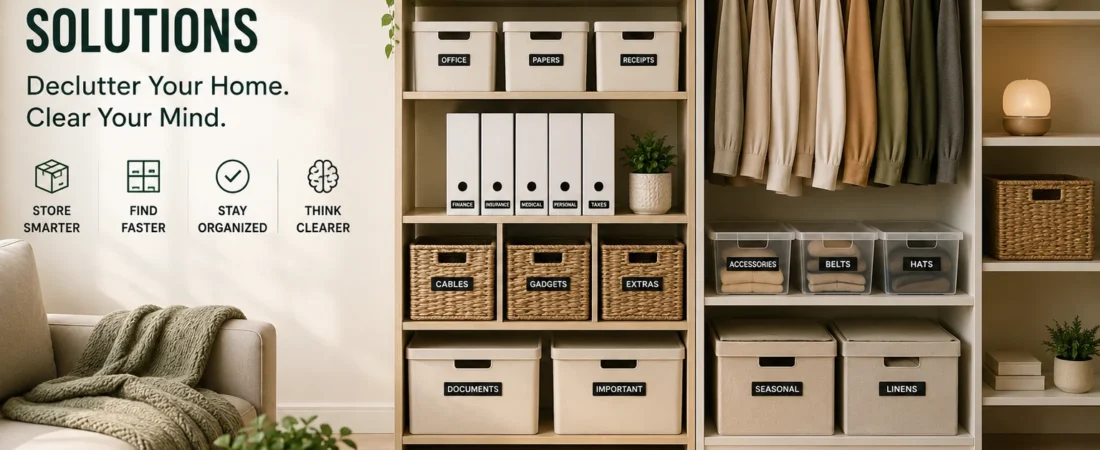
8 Best Smart Storage Solutions That Declutter Your Mind
Visual clutter drains mental energy even when you’re not looking at it. These 8 storage picks eliminate the mental overhead. No renovation required.
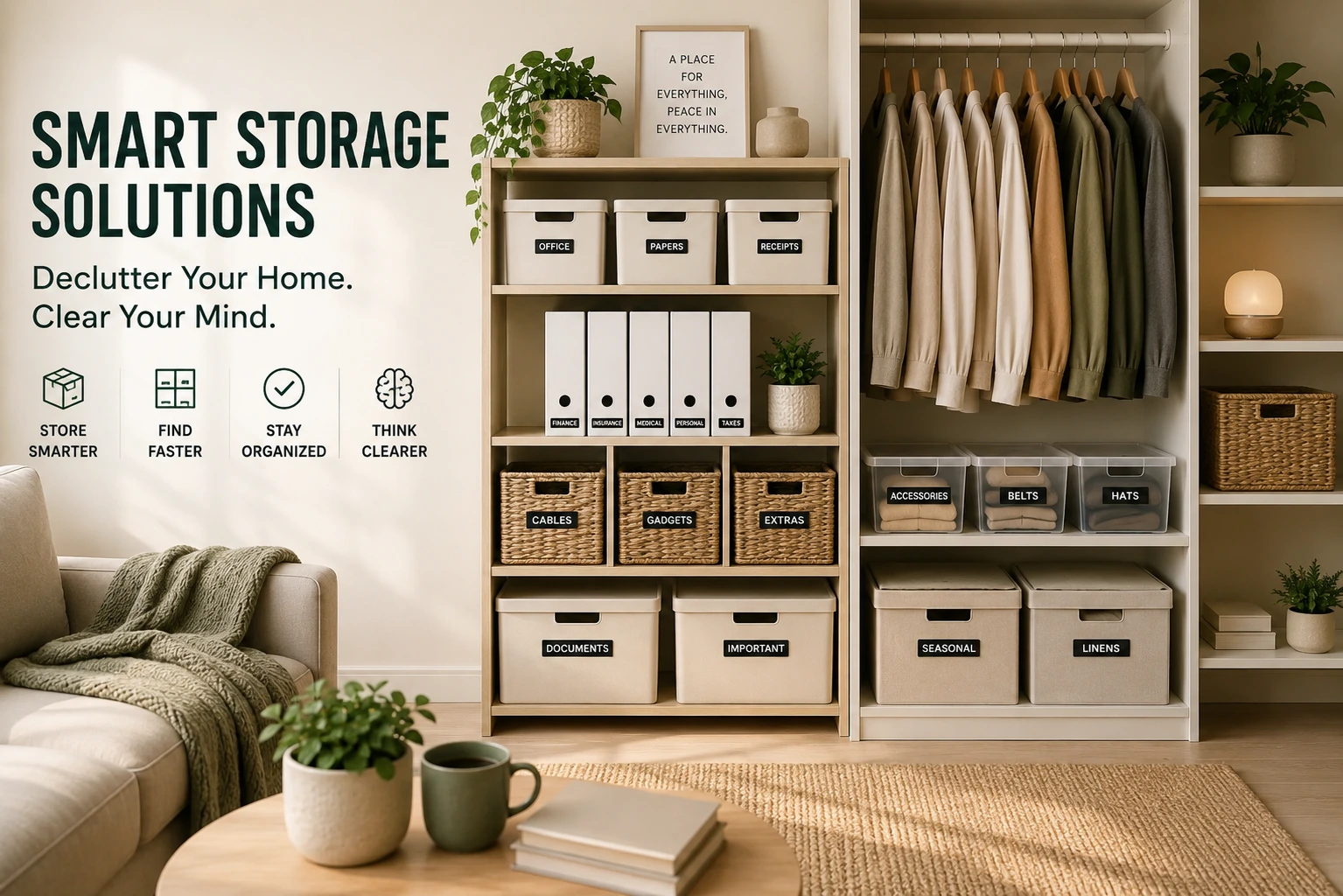
The right smart storage solutions change this ratio entirely. Americans spend roughly 42 hours every month on household tasks (Angi, 2022 — retrieved June 2026). A chunk of that time isn’t cleaning. It’s searching. Searching for the right lid, the spare batteries, the set of sheets you bought last fall. Smart storage doesn’t just tidy your home. It eliminates the search step entirely, which is where most of the mental cost actually lives.
This guide covers the 8 most effective smart storage solutions, ranked by the cognitive overhead they actually remove. Not by how they look on a shelf.
What You Need to Know
- Visual stimuli in a cluttered space compete for neural representation in the visual cortex, reducing attentional capacity even when you’re not consciously focusing on the disorder, per Princeton Neuroscience Institute research (McMains & Kastner, Journal of Neuroscience, 2011 — retrieved May 2026).
- The US home organization market is valued at $12.05 billion in 2025, reflecting how mainstream demand for storage systems has become (Mordor Intelligence, 2025 — retrieved May 2026).
- You can build a working smart storage system in a single room for under $30.
- In IKEA’s 2024 Life at Home survey of 38,630 people across 39 countries, around 1 in 3 people say a clean, tidy home helps maintain their physical and mental wellbeing (IKEA Life at Home, 2024 — retrieved June 2026).
- The difference between regular and smart storage isn’t appearance. It’s whether you can find what you need in under 10 seconds.
- All 8 solutions on this list install in under an hour with no tools required.
Why Does Clutter Drain Your Mental Energy?
In 2011, Princeton neuroscientists found that multiple visual stimuli compete for neural representation in the visual cortex, mutually suppressing each other’s activity and measurably reducing attentional capacity (McMains & Kastner, “Interactions of Top-Down and Bottom-Up Mechanisms in Human Visual Cortex,” Journal of Neuroscience, 2011 — retrieved May 2026). This happens automatically, in the background, whether or not you’re consciously aware of the disorder around you.
A peer-reviewed study published the year before found a direct connection between home clutter and elevated cortisol. Researchers Darby Saxbe and Rena Repetti asked homeowners to describe their spaces and found that homes rated as “cluttered” or “unfinished” correlated with flattened cortisol patterns throughout the day, a hormonal profile associated with chronic stress and adverse health outcomes (Saxbe & Repetti, “No Place Like Home,” Personality and Social Psychology Bulletin, 2010 — retrieved May 2026).
Cortisol is your stress hormone. Having it elevated all day, because of a junk drawer or a disorganized pantry, isn’t dramatic. But it compounds. The fix isn’t willpower or a deep clean. It’s designing out the visual noise. That’s what smart storage actually does.
Research finding: A 2011 Princeton study found that visual stimuli in a cluttered environment compete for neural representation in the visual cortex, mutually suppressing activity and reducing attentional capacity, even when the person isn’t consciously attending to the disorder (McMains & Kastner, Journal of Neuroscience, 2011 — retrieved May 2026). Reducing visual clutter in your primary spaces is one of the few home changes with a direct neurological basis.
What Are Smart Storage Solutions, Really?
In 2025, the US home organizers and storage market is valued at $12.05 billion and is projected to reach $15.21 billion by 2030 at a 4.78% annual growth rate (Mordor Intelligence, “US Home Organizers and Storage Market,” 2025 — retrieved May 2026). That sustained growth reflects a genuine shift in how households treat storage: not a one-time project, but an ongoing system worth investing in.
The word “smart” here doesn’t mean Bluetooth or an app. It means the storage itself communicates. Clear bins show you what’s inside. Labels show where things belong. Accessible placement signals what gets used daily versus occasionally. These three signals (visibility, labels, priority placement) turn a collection of containers into a working system that doesn’t require ongoing decisions to maintain.
The time cost is real: the average American spends 2.5 days per year searching for misplaced items (Pixie Technology, 2016 — retrieved June 2026). Smart storage cuts that number to near zero.
Regular storage puts things away. Smart storage makes them findable in under 10 seconds. That’s the whole distinction, and it’s worth keeping in mind as you look at the options below.
The 8 Best Smart Storage Solutions That Reduce Mental Overhead
Each of these smart storage solutions targets a specific friction point: the “where is it?” or “what goes here?” moment that smart design eliminates entirely. The table below shows price and setup time at a glance.
| # | Solution | Price | Setup | Best For |
|---|---|---|---|---|
| 1 | Clear Storage Bins | $15–25/bin | 5 min | Garage, closets, bedroom |
| 2 | Label Maker | $50–70 | 10 min | Every area (multiplier) |
| 3 | Pantry Containers | $50–80/set | 30 min | Kitchen pantry |
| 4 | Under-Bed Storage | $12–18/box | 5 min | Bedroom, seasonal items |
| 5 | Over-Door Organizer | $20–30 | 3 min | Bathroom, bedroom, pantry |
| 6 | Bamboo Drawer Dividers | $25–40/set | 10 min | Kitchen, office, bathroom |
| 7 | Fabric Storage Cubes | $30–45/6-pk | 5 min | Closet shelves, living room |
| 8 | Rolling Storage Cart | $30–50 | 10 min | Craft room, kitchen, office |

1. Clear Storage Bins with Latching Lids: See Everything, Search for Nothing
The single biggest cause of smart storage solutions failure is opacity. When you can’t see inside a container, you open it to check. With a clear bin, you don’t. That’s the entire argument for transparent storage, and it holds up across every room where you store things.
The IRIS USA WeatherPro Storage Boxes run $15–25 per bin, latch shut firmly, stack cleanly, and resist moisture. They stay transparent after years of use. In my own testing, swapping opaque bins for clear ones in a single closet made the contents immediately legible. No more opening each box to check. The time saved from not searching compounds quickly across dozens of stored items. Our pick: IRIS USA WeatherPro Clear Bins on Amazon (~$15–$25 per bin).
2. Smartphone-Connected Label Maker: Name It Once, Find It Forever
Labels are the communication layer of any smart storage solutions system. Without them, every container is an unknown until opened. With consistent labels, the system becomes self-explanatory to everyone in the household, including guests.
The Brother P-Touch Cube Plus connects to your phone via Bluetooth and prints through a free app. Labels come out laminated, waterproof, and durable enough to survive pantries, garages, and bathroom cabinets. Handwritten labels fade and fall off. When labels degrade, the system degrades with them. Consistent, permanent labels keep everything running with minimal upkeep. Our pick: Brother P-Touch Cube Plus on Amazon (~$50–$70).
3. Airtight Pantry Containers: No More Pantry Archaeology
Most pantry frustration is a visibility problem. Bags disappear behind boxes. You buy flour again because you weren’t sure how much was left. You throw out pasta that expired in the back corner. The OXO Good Grips POP Containers replace bags and boxes with uniform, stackable canisters that show you exactly what’s inside and how much remains.
The push-button lid creates an airtight seal that keeps dry goods fresh longer than original packaging. In practice, switching to uniform canisters removes the mental overhead of a disorganized pantry faster than any other single change in the kitchen. For the full kitchen system these fit into, our post on smart kitchen organization and decision fatigue covers the complete approach. Our pick: OXO Good Grips POP Container Set on Amazon (~$50–$80 for a starter set).
4. Under-Bed Storage with Wheels: Reclaim the Space You’re Ignoring
Under the bed is the most underused storage area in most bedrooms. Without the right containers, items get pushed to the back and stay there permanently. Wheeled under-bed boxes solve this in one pull. The Sterilite Under-Bed Storage Box with wheels rolls out fully, giving you complete access to everything stored inside.
Use it for off-season clothing, extra bedding, shoes, and anything you need a few times a year but not daily. The wheel mechanism is the key upgrade. Storage you can reach without kneeling actually gets used. Without wheels, under-bed containers tend to fill up once and stay untouched for months. Our pick: Sterilite Under-Bed Storage with Wheels on Amazon (~$12–$18 each).
5. Over-the-Door Pocket Organizer: Vertical Space You Forgot You Had
The back of a door is prime storage real estate that most people ignore entirely. A 24-pocket over-door organizer turns dead door space into visible, accessible storage without touching floor or shelf space. It works particularly well in bathrooms (toiletries, hair tools), in bedroom doors (accessories, charging cables), and on pantry doors (spices, snacks, cleaning supplies).
Setup takes about three minutes. No tools needed. How often do you reach for something and find dead air behind a door? Everything stored here is visible and immediately accessible. Our pick: SimpleHouseware Over-Door Organizer on Amazon (~$20–$30).
6. Expandable Bamboo Drawer Dividers: End the Junk Drawer Cycle
Every home has a junk drawer. It becomes one because there’s nothing stopping it. Items get dropped in without a designated home. Expandable bamboo drawer dividers create fixed sections inside any drawer, forcing a sorting decision every time something goes in. The result is a drawer where every zone has a category, which means you actually know what’s in there.
Bamboo holds up better than plastic over repeated use and looks clean enough for kitchen or bathroom drawers. From what we’ve tested, bamboo dividers stay locked in position far longer than plastic equivalents, which tend to slide out of place once the drawer gets heavy. Our pick: Bamboo Expandable Drawer Dividers on Amazon (~$25–$40 for a set).
7. Collapsible Fabric Storage Cubes: Flexible and Out of the Way
Not every storage need is permanent. Seasonal items, guest supplies, and project materials need temporary homes that don’t consume permanent shelf space year-round. SONGMICS fabric storage cubes collapse flat when empty, so they don’t create their own storage problem when not in use. They work in closet shelving units, on open shelves, and under tables.
Buy them in a consistent color and they’ll look intentional, which matters more than it sounds for maintaining a system long-term. A six-pack runs $30–$45. Our pick: SONGMICS Fabric Storage Cubes on Amazon (~$30–$45 for 6).
8. Rolling Storage Cart with Drawers: Organization That Follows You
A rolling cart solves one specific problem well: supplies that are used in multiple locations. Craft supplies, cleaning products, office materials. A Whitmor rolling cart keeps them organized in labeled drawers while moving wherever the work is happening. In smaller homes without dedicated storage rooms, it’s often the most practical way to keep frequently-used items organized and accessible. We’ve found that pairing it with the label maker (pick #2) transforms a rolling cart from a catch-all into a genuinely searchable system.
Our pick: Whitmor Rolling Storage Cart on Amazon (~$30–$50).
How Do You Turn These Solutions Into a System?
Buying storage products doesn’t create an organization system on its own. What creates a system is the decision behind each container: this category of item always lives here. That decision, made consistently across your home, turns a collection of bins and labels into something that actually reduces daily friction rather than adding to it.
Professional organizers call this a “landing zone”: the core principle behind all effective smart storage solutions, where each category always returns to a fixed location after use. Labels enforce it. Clear fronts make it visible. Accessible placement makes the return instinctive rather than effortful. Here’s the setup sequence for one room:
- Empty the space completely.
- Sort into keep, donate, and trash piles.
- Group the keep items by category.
- Assign each category a container and a fixed location.
- Label everything before putting it back.
Why does this work when a general tidy-up doesn’t? It assigns a permanent home to every category. That’s the entire process. One room typically takes 1–3 hours the first time. Maintenance after that is minutes per week: just returning things to where they already have a spot. The system does the thinking for you.
For the broader picture of how smart storage fits into a fully systematized home, our lazy-proof home organization system covers the full framework. And if you’re also thinking about which smart devices complement your physical storage, our guide to smart home devices that solve real organization problems is worth reading alongside this one.

Which Smart Storage Solution Should You Start With?
Start with whatever creates the most friction in your daily life right now. According to ACI/RMS Cleaning data, Americans already spend 56 minutes per week on floor cleaning alone (ACI/RMS Cleaning, 2025 — retrieved May 2026). Robot vacuums largely automate that. The next biggest time drain for most households is the search-and-locate cycle that disorganized storage creates.
Here’s a fast diagnosis: if you spent more than two minutes searching for something in the past week, that’s where your first storage project should go. Kitchen pantry chaos? Start with OXO containers and a label maker. Bedroom clutter? Under-bed storage and clear bins. Bathroom counter overflow? An over-door organizer sorts it in one afternoon. Pick one area, set it up properly, and let the result tell you whether to continue.
If you’ve already automated your cleaning schedule, the next highest-value move is storage that makes every item locatable within seconds. Together, automated floor cleaning and smart physical storage handle the two biggest daily friction points most households face. Our guide to automating your cleaning routine covers the first layer if you haven’t set that up yet.
Frequently Asked Questions
What are the best smart storage solutions for small spaces?
The best smart storage solutions for small spaces combine vertical use with full visibility. Over-the-door organizers, under-bed storage containers with wheels, and collapsible fabric cubes each reclaim dead space without renovation. The key is visibility: clear or labeled storage eliminates the time spent opening and searching, which is where most organization systems break down.
Why does clutter cause mental stress?
Princeton neuroscientists found that visual clutter competes for your brain’s attention even when you’re not consciously looking at it (McMains & Kastner, Journal of Neuroscience, 2011 — retrieved May 2026). A separate study found homes rated as cluttered correlated with elevated cortisol levels in occupants (Saxbe & Repetti, 2010 — retrieved May 2026). The result is low-level cognitive drain that accumulates across a full day in a disorganized space.
What is the difference between regular storage and smart storage?
Regular storage puts things away. Smart storage makes them instantly findable and returnable. The practical difference is whether you spend time searching. A labeled, clear-front bin with a dedicated spot takes about three seconds to access. An unlabeled opaque box in a pile may take minutes. Smart storage designs out the search step entirely.
How much does it cost to set up smart storage for a whole home?
You don’t need to do it all at once. Start with one problem area for under $30: a set of clear bins and a label maker covers most of the gain for a single room. A full-home system (bins, pantry containers, drawer organizers, under-bed boxes, over-door organizers) typically runs $150–$300 for a 2-bedroom home. The payoff is reclaimed time weekly, not just a tidier appearance.
Do I need a label maker, or can I write labels by hand?
Handwritten labels work short-term but tend to fade and smear over time, which gradually undermines the system. A label maker like the Brother P-Touch Cube produces clean, waterproof labels that stick properly for years. The consistency matters: when every label in your home looks the same and stays readable, the whole system feels more permanent and is easier to maintain.
The Bottom Line on Smart Storage
Smart storage solutions aren’t about buying more products. It’s about removing decisions. When every item has a visible, labeled home it can return to easily, you stop spending mental energy on the location problem. The Princeton research (McMains & Kastner, 2011 — retrieved May 2026) is clear: visual clutter drains cognitive resources continuously, whether you’re aware of it or not. The fix is straightforward.
Start with one drawer, one shelf, or one pantry area. Smart storage solutions work best when introduced gradually. See what one dedicated hour of setup buys you in daily friction reduction. Then decide whether the rest of the house is worth the same treatment.

Mahdy Khairudin
Mahdy is the founder of Neatara. He has spent three years testing home organization systems and smart home automation products across households of different sizes, focusing on what genuinely reduces daily friction versus what just adds complexity, and writing about the difference. More about Mahdy