
How to Organize Your Kitchen to Beat Decision Fatigue: A 2026 Smart System
In 2025, 58% of homeowners said cluttered kitchens cause daily stress — it’s not a mess problem. Here’s a 5-step system that removes daily micro-decisions and saves up to $2,913/year.
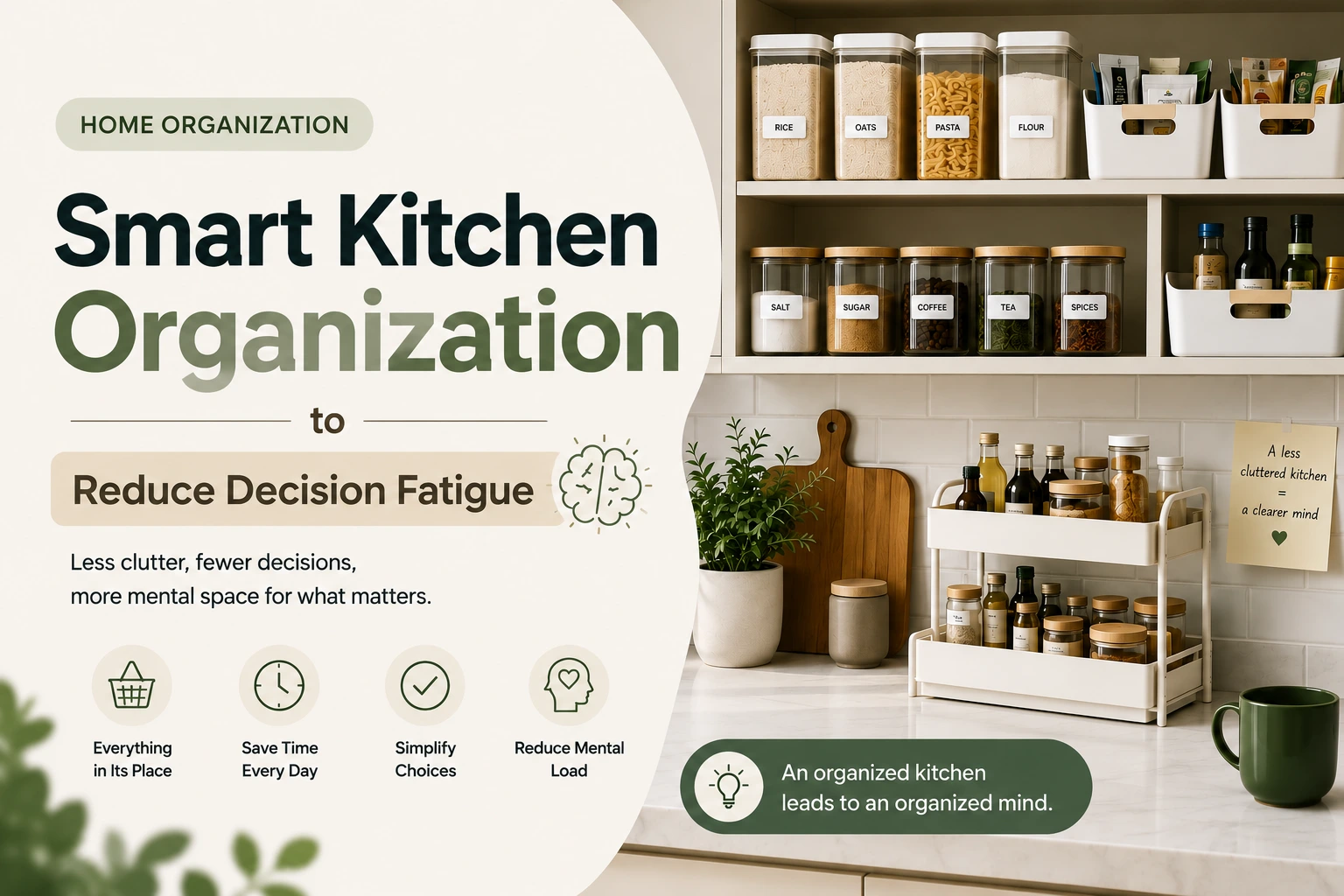
The average American makes roughly 35,000 decisions every day, according to research compiled by The Decision Lab (The Decision Lab, 2024 — retrieved May 2026). The kitchen is where a disproportionate share of those decisions happen before 8 AM: what to eat, what to prep, where the strainer went, whether the pantry has enough pasta for tonight.
I rebuilt my own kitchen around this problem, and the difference wasn’t a new layout or expensive gadgets — it was removing decisions from the equation entirely. This guide gives you a 5-step system for doing the same. It connects directly to the broader lazy-proof home organization system we’ve built for every room. Each step takes 15–30 minutes and works independently.
What You Need to Know
- In 2025, 58% of homeowners said cluttered countertops cause daily stress — a decision-volume problem, not a willpower one (Eagle Woodworking, 2025 — retrieved May 2026).
- American households of four waste an average of $2,913 per year on food bought but never used — a figure cut dramatically by a 2-week meal rotation (U.S. EPA, 2025 — retrieved May 2026).
- This 5-step system starts with a free 15-minute countertop audit and builds to two automated touchpoints for under $50 total.
- Steps 1–4 require no devices at all. Smart devices in Step 5 amplify the system but aren’t its foundation.
Why Does Your Kitchen Drain Your Brain Before You’ve Even Cooked Anything?
In 2024, researchers at Princeton Neuroscience Institute confirmed that visual clutter in a physical environment directly competes for cognitive resources, reducing working memory capacity and increasing perceived cognitive load (Princeton Neuroscience Institute, “Visual Clutter Study,” cited 2024–2025 — retrieved May 2026). The kitchen is the most visually cluttered room in most homes. Counters covered with appliances, drawers that resist opening, and an opaque pantry all add friction to every food decision you make.
A 2024 study published in Psychology Today citing Saxbe and Repetti’s research found that women living in cluttered homes showed elevated cortisol levels throughout the day — the stress hormone that impairs decision-making and memory (Psychology Today / Saxbe & Repetti, “Clutter and Cortisol,” September 2024 — retrieved May 2026). This isn’t about aesthetics. It’s about cognitive load. A disorganized kitchen isn’t just harder to cook in — it makes thinking harder.
A 2025 survey of 1,000 homeowners by Eagle Woodworking found that 62% want clear countertops as their top kitchen priority, while 58% said kitchen clutter causes them daily stress (Eagle Woodworking, “Kitchen Organization Survey,” 2025 — retrieved May 2026).
What Is the First Move in a Smart Kitchen Organization System?
According to the Bureau of Labor Statistics American Time Use Survey (BLS, 2024 — retrieved May 2026), Americans spend an average of 40 minutes per day on food preparation and cleanup. That’s nearly 5 hours per week. The first move is a countertop audit. Here’s the full system at a glance — start at Step 1 and add layers only when the previous one is working.
| Step | Action | Time Required | Cost |
|---|---|---|---|
| Step 1 | Clear countertops | 15 minutes | Free |
| Step 2 | Zone by frequency | 20 minutes | Free |
| Step 3 | Build pantry system | 20 minutes | Free (or ~$20 for containers) |
| Step 4 | Set up meal rotation | 60 minutes (once) | Free |
| Step 5 | Automate two touchpoints | 10 minutes | $30–$50 |
When I ran this audit on my own kitchen, 11 items came off the counter permanently — including an air fryer used twice in three months and a fruit bowl acting mainly as a coin collector. Morning time in the kitchen dropped from 22 minutes to under 12.
Step 1 — Clear Your Countertops (One Rule, 15 Minutes)
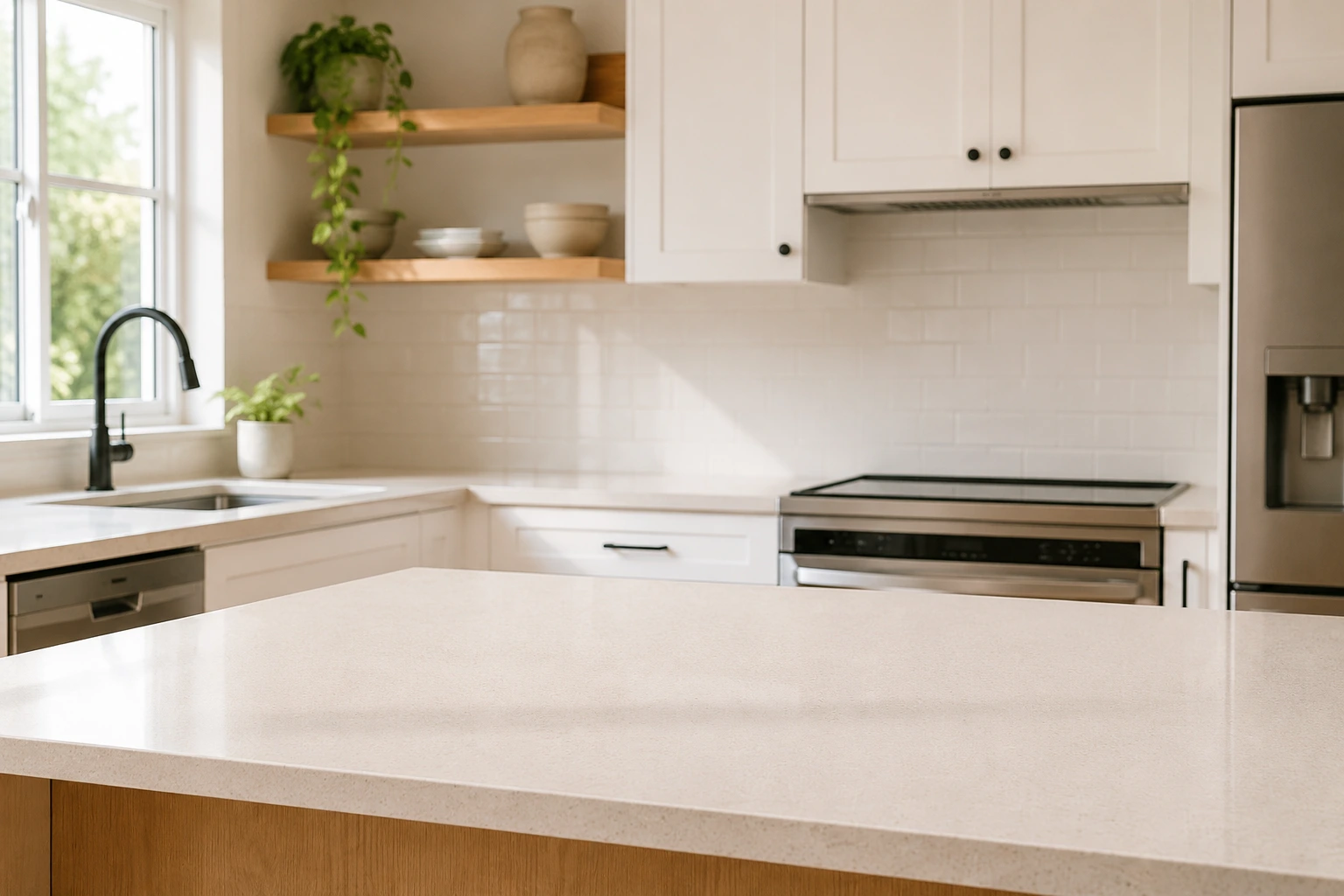
The one rule: if you don’t use it four or more times per week, it doesn’t live on the counter. Apply it without exceptions for 15 minutes. You’re not deciding whether to keep items — just whether they earn counter real estate. Items that don’t pass go into a drawer, cabinet, or donation box.
The goal isn’t minimalism for its own sake. It’s reducing the visual noise your brain filters every time you enter the kitchen. Eagle Woodworking’s 2025 survey found 62% of homeowners specifically cite clear countertops as their top priority — not because it looks good, but because it removes a daily micro-stressor before the day’s larger decisions begin.
Step 2 — Zone Your Drawers and Cabinets by Frequency
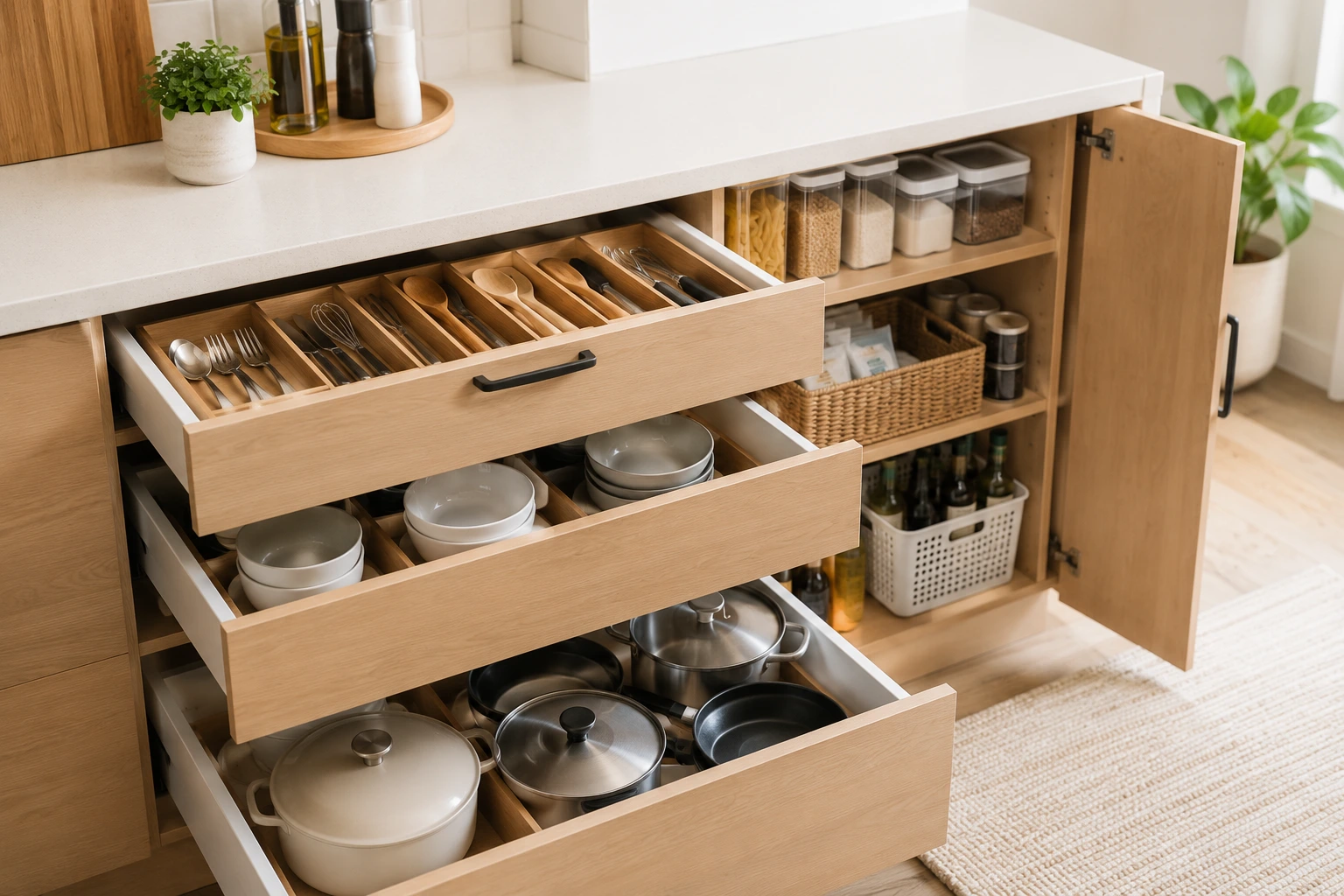
Most kitchen organization guides focus on aesthetics: matching containers, color-coded shelves, Instagram-ready pantries. The smarter approach is frequency mapping. Divide your storage into three zones: daily-use items within arm’s reach, weekly-use items at eye level or in accessible lower cabinets, and monthly-or-less items in high or deep storage. This isn’t about labels — it’s about eliminating the search-and-retrieve decision you make dozens of times per day.
The 42% of homeowners who told Eagle Woodworking they “waste time searching for items daily” aren’t disorganized — they’re using a system optimized for appearance rather than retrieval speed. Frequency zoning fixes that. It also pairs well with the smart home devices that solve specific organization problems — a motion-activated cabinet light in your most-used zone removes friction from reaching into a dark lower cabinet entirely.
Step 3 — Build a Uniform Pantry System
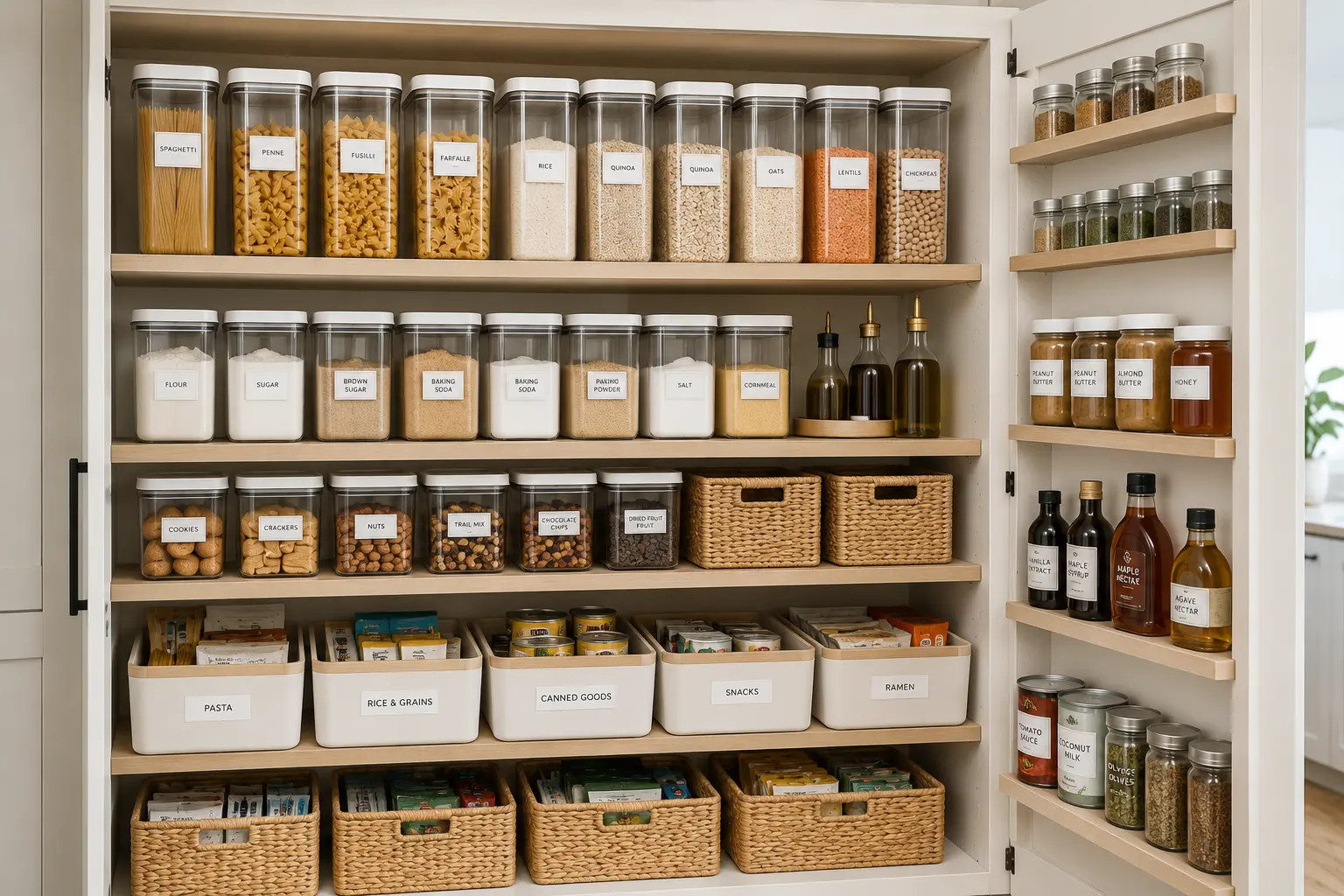
The most underused pantry move isn’t buying matching containers — it’s creating a single eye-level visibility row. Move your most-used dry goods (grains, pasta, canned staples) to one shelf at eye level, all facing forward. You’ll see at a glance what’s there, what’s running low, and what to buy. It takes 20 minutes to set up and eliminates the “do we have enough?” decision that interrupts every weekly meal plan.
Uniform containers do help — not because they look organized, but because they stack efficiently and let you see fill levels. Clear glass or BPA-free plastic with wide mouths works well for grains and legumes. The goal is frictionless inventory visibility, not a styled shelf photo.
Step 4 — Set Up a 2-Week Meal Rotation
By the numbers: According to a 2025 U.S. EPA report, American households of four waste an average of $2,913 per year on food that is purchased but never consumed — nearly double the $1,500 figure from a decade ago. The primary driver is not over-shopping but the absence of a system connecting pantry inventory to actual weekly cooking decisions (U.S. EPA, “Estimating the Cost of Food Waste to American Consumers,” 2025 — retrieved May 2026).
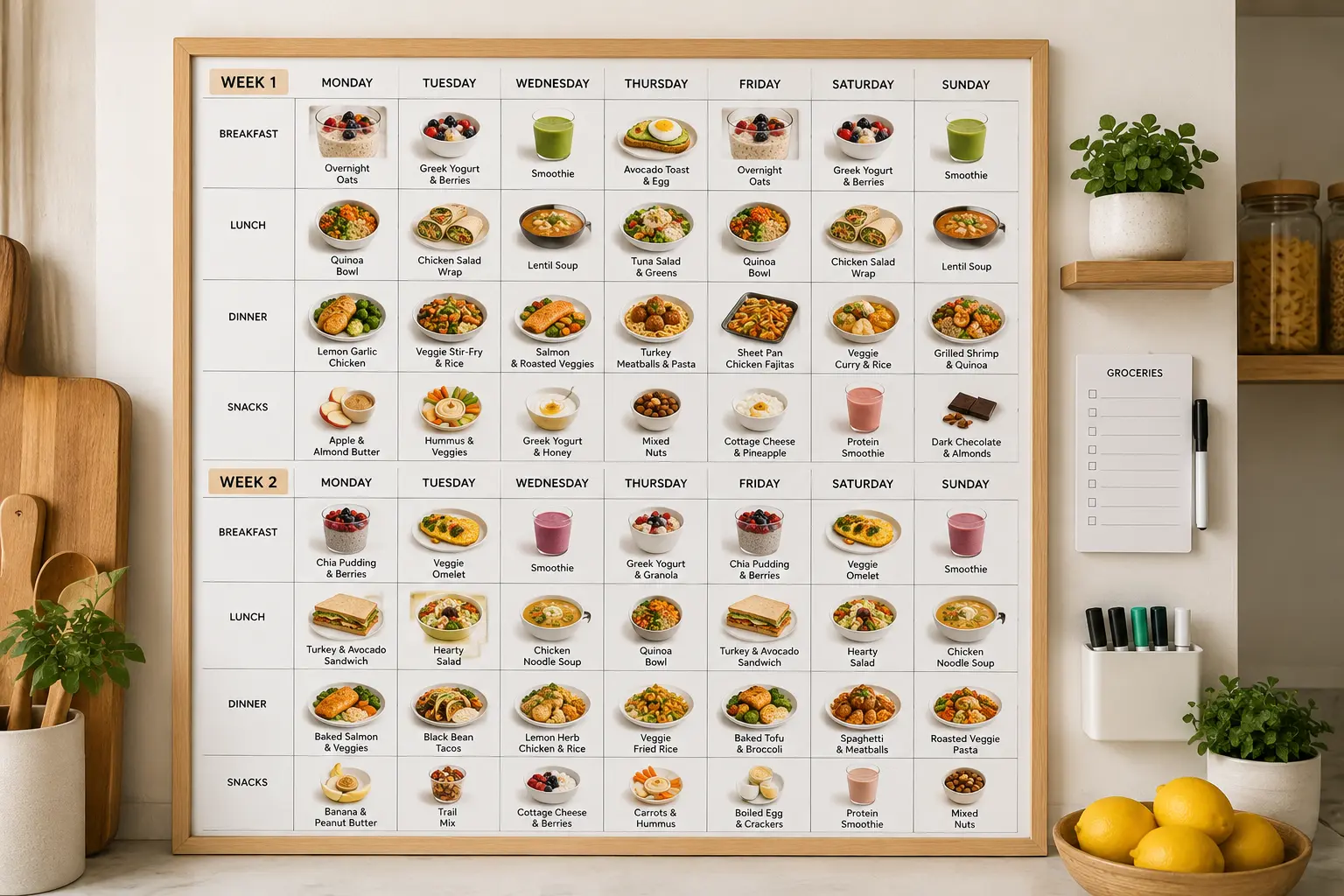
A 2-week rotation means you have 14 dinners mapped out, rotating on repeat. You’re not deciding what to cook each night — you’re executing a plan you made once. The first two weeks take effort to build. After that, the system runs on autopilot. Your pantry, shopping list, and weekly prep all align to the same 14-meal cycle, eliminating the most decision-heavy daily question in most households: “What are we having tonight?”
Step 5 — Automate Two Kitchen Touchpoints
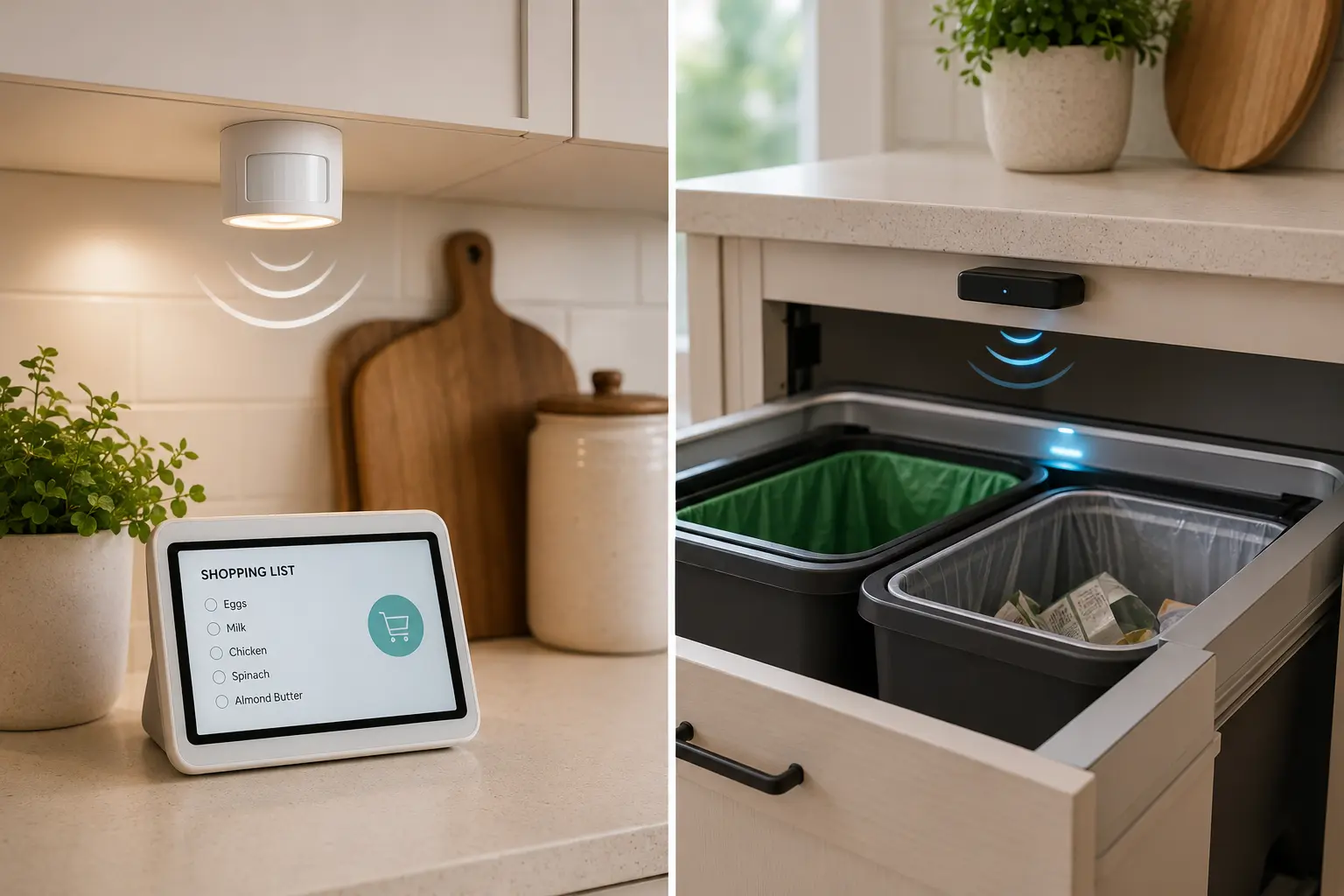
By 2025, smart appliance penetration in U.S. kitchens reached 12.9%, with projections showing 30.8% adoption by 2029 (Statista, “Smart Kitchen Appliances Market in the U.S.,” 2025 — retrieved May 2026). You don’t need to be an early adopter. Two touchpoints deliver the biggest decision-reduction impact for the lowest cost.
Touchpoint 1 — Touchless soap dispenser ($40–$60): The Simplehuman Rechargeable Sensor Pump removes the pump decision and the cross-contamination step every time you handle raw ingredients. It sounds trivial until you realize you’re making that micro-decision 12–20 times during a cooking session. USB rechargeable, zero Wi-Fi, zero app required.
Touchpoint 2 — Smart plug for your most-used small appliance ($15–$25): Set your coffee maker, kettle, or air purifier on a daily schedule with a Kasa Smart Plug Mini. You stop deciding whether to turn it on. For a full breakdown of how smart plugs slot into a room-by-room system, see our guide to automating your cleaning and home routine — the same Tier 1 device logic applies here.
What Does This System Actually Save You?
In 2025, smart kitchen appliances represented 12.9% of U.S. kitchen appliance penetration. Statista projects that figure will more than double to 30.8% by 2029 (Statista, 2025 — retrieved May 2026). Here’s what the 5-step system returns concretely.
- Time: Americans spend 40 min/day on food prep (BLS 2024). Eliminating searching, decide-and-abandon loops, and repeat-decision cycles conservatively saves 10–15 minutes per day.
- Money: Up to $2,913/year in food waste recovered through the meal rotation and pantry visibility system (U.S. EPA, 2025).
- Cognitive load: Fewer micro-decisions before 9 AM means more working memory available for the day’s actual work.
Frequently Asked Questions
How long does it take to set up a smart kitchen organization system?
Each step in this system takes 15–30 minutes to implement independently. The countertop audit (Step 1) is the fastest at 15 minutes. The meal rotation (Step 4) requires a 45–60 minute planning session to build your first 14-dinner cycle, then runs on repeat. Total setup time across all 5 steps: roughly 3–4 hours, spread over a weekend.
Does kitchen organization actually reduce stress?
In 2025, 55% of homeowners in a survey of 1,000 said a more organized kitchen would directly reduce their daily stress (Eagle Woodworking, 2025 — retrieved May 2026). Research on cortisol levels in cluttered environments supports this: visual disorder elevates stress hormones throughout the day (Saxbe & Repetti, cited in Psychology Today, 2024). Organization works by removing repeated low-level decisions, not through aesthetics.
What’s the cheapest first step to organize a kitchen?
Step 1 costs nothing: clear your countertops using the 4×-per-week rule. Move everything that doesn’t meet the threshold into a cabinet, drawer, or donation box. This single change reduces visual clutter and daily micro-decisions immediately. A $15 smart plug is the cheapest automation entry point if you want to add one device.
How much food does the average household waste per year?
According to a 2025 U.S. EPA report, households of four waste an average of $2,913 per year on food purchased but not consumed (U.S. EPA, 2025 — retrieved May 2026). The 2-week meal rotation in Step 4 directly addresses the root cause: misalignment between what’s in the pantry and what’s actually being cooked each week.
Do I need smart appliances to reduce kitchen decision fatigue?
No. Steps 1–4 of this system require no devices at all — just reorganization. Smart devices in Step 5 amplify the system but aren’t its foundation. A touchless soap dispenser and a single smart plug cover the highest-ROI automation at under $50 combined. Smart kitchen appliance adoption is projected to reach 30.8% by 2029 (Statista, 2025 — retrieved May 2026) — you’re still ahead of the mainstream curve.
Start This Weekend
Kitchen decision fatigue isn’t solved by a deep clean or a new appliance. It’s solved by reducing the number of daily micro-decisions the kitchen forces on you. The 5-step system does that in a specific order: clear counter first, zone next, systematize the pantry, automate the menu, add two touchpoints, and let the whole thing run.
Start with Step 1 this weekend. Fifteen minutes, no purchases required. Once the counter is clear, you’ll feel the cognitive shift immediately — and you’ll have the momentum to add the next layer. For a full room-by-room version of this approach, the lazy-proof home organization system applies the same decision-removal logic to every room in the house.

Mahdy Khairudin
Mahdy is the founder of Neatara. He researches home organization systems and smart home automation for budget-conscious homes — focusing on what genuinely reduces daily friction versus what just adds complexity. More about Mahdy