
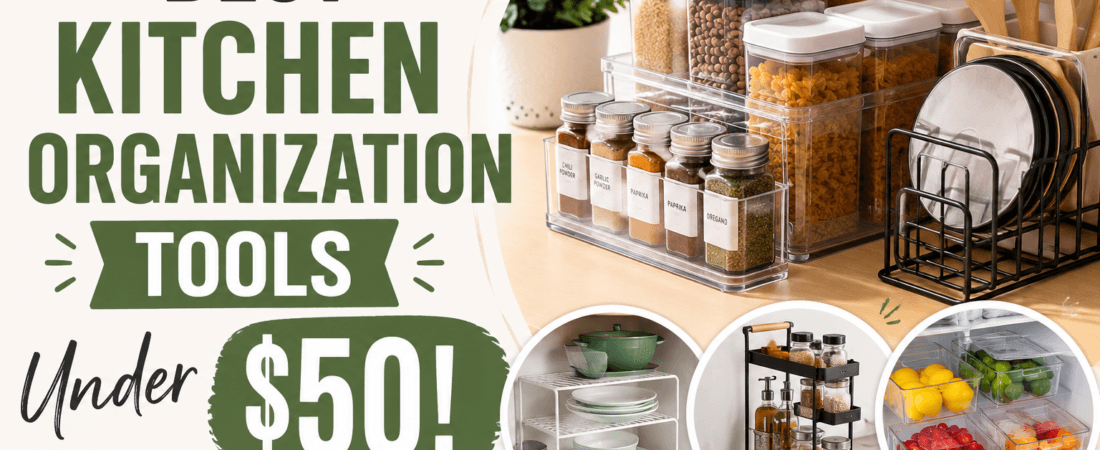
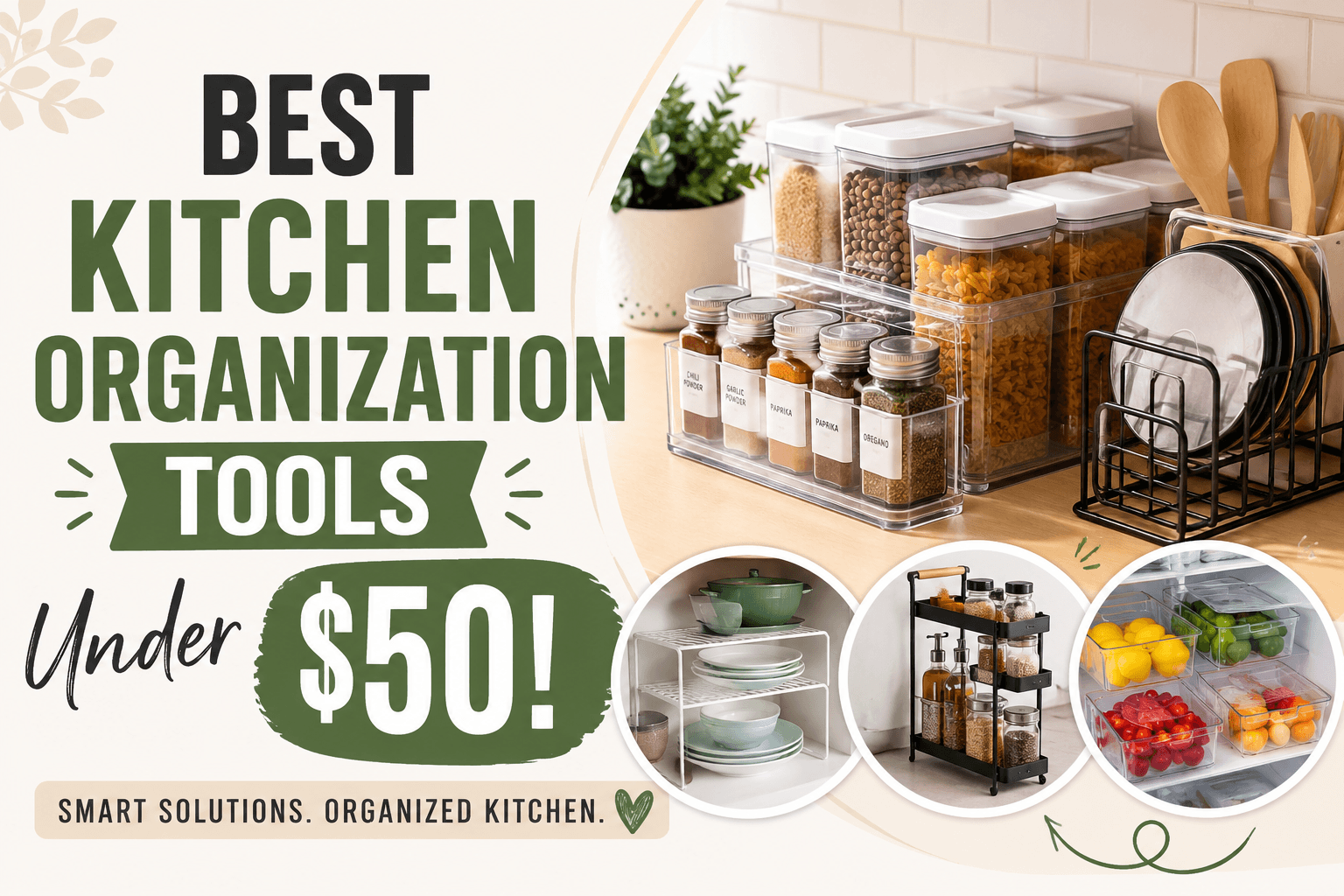
Best Kitchen Organization Tools Under $50 (Researched by Category)
From drawer dividers to pantry bins — a category-by-category breakdown of what actually works, at prices that don’t require a renovation budget.
Forty-two percent of homeowners say they waste time every single day searching for items in their kitchen — and 58% report that kitchen clutter is a consistent source of daily stress (Eagle Woodworking, Jan 2025). Those are not marginal numbers. They describe most households, including mine before I started paying attention to what actually addresses the problem versus what just looks organized in an Instagram photo.
This post covers the six tool categories that make the biggest practical difference in a real kitchen. For each category I’ve listed what to look for, a realistic price range as of early 2026, and — critically — the limitations you’ll want to know before adding something to a cart. Everything here stays under $50 per purchase.
What You Need to Know
- Drawer organizers deliver the fastest visible improvement for most kitchens — start there before buying anything else.
- Clear bins outperform opaque ones for pantry and under-sink storage because visibility prevents re-clutter from forming.
- Measure interior dimensions before buying — exterior measurements routinely cause returns and frustration.
- Buy one category at a time and live with it for two weeks before expanding the system.
What makes a kitchen organizer worth buying?
Most kitchen organizers fail not because they’re poorly made, but because they don’t match the actual space or habit they’re intended to fix. Before spending anything, I run every product through five questions:
- Does it fit the exact space? This means measuring interior dimensions — width, depth, height — not eyeballing the gap.
- Is it easy to clean? A pantry bin that collects crumbs in textured corners will be abandoned within a month.
- Does it solve a specific behavior, not just look organized? A spice rack is useful only if spice disorganization is your actual bottleneck.
- Can it expand later? Modular systems cost more upfront but avoid the buy-everything-over-again trap when needs change.
- Is the price proportional to the problem? A $45 solution for a problem that causes 30 seconds of friction per week is a poor trade regardless of build quality.
Drawer organizers: highest-return starting point
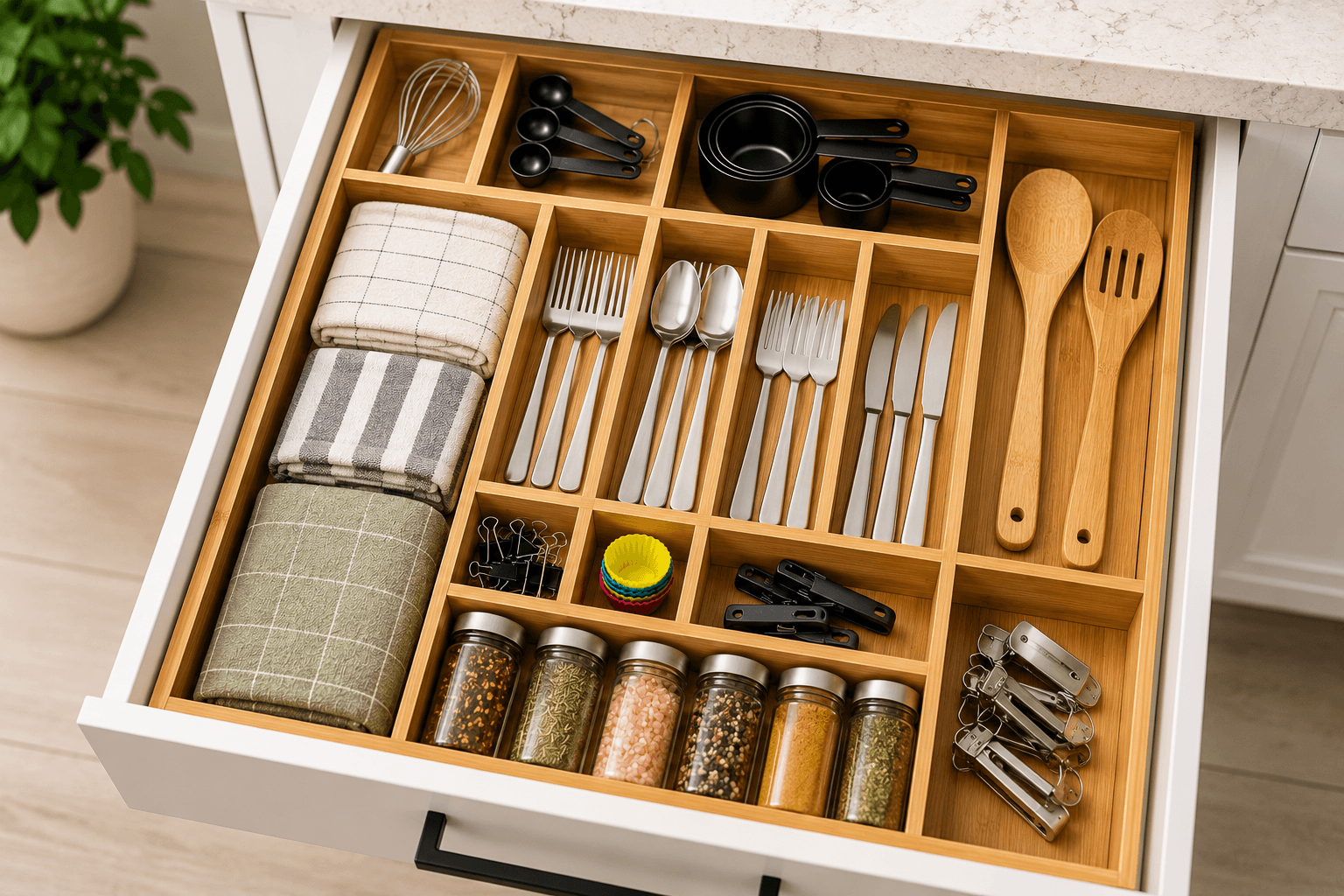
Kitchen drawers are the single highest-friction storage area in most homes. Sixty-seven percent of homeowners say organizing kitchen drawers is their top organization priority, and 42% waste time searching through them daily (Eagle Woodworking, Jan 2025). That combination — high frequency, clear priority — is the strongest case for starting here before any other purchase.
Drawer Organizer Inserts · $10–$30
Best for: Utensil drawers, junk drawers, cutlery zones
Our pick: SpaceAid Bamboo Drawer Dividers (~$23) — includes labeled inserts, spring-loaded to fit any drawer width from 17–22 inches.
What to look for: Interior-adjustable dividers that grip drawer walls without adhesive; bamboo or BPA-free polypropylene for food-adjacent drawers; depth that matches your actual drawer interior, not just the opening
Limitation: Non-expandable inserts often leave gaps in non-standard drawer widths, which become secondary clutter zones within weeks. Confirm the product’s listed adjustment range matches your measurement before ordering.
Pantry bins and labeled containers
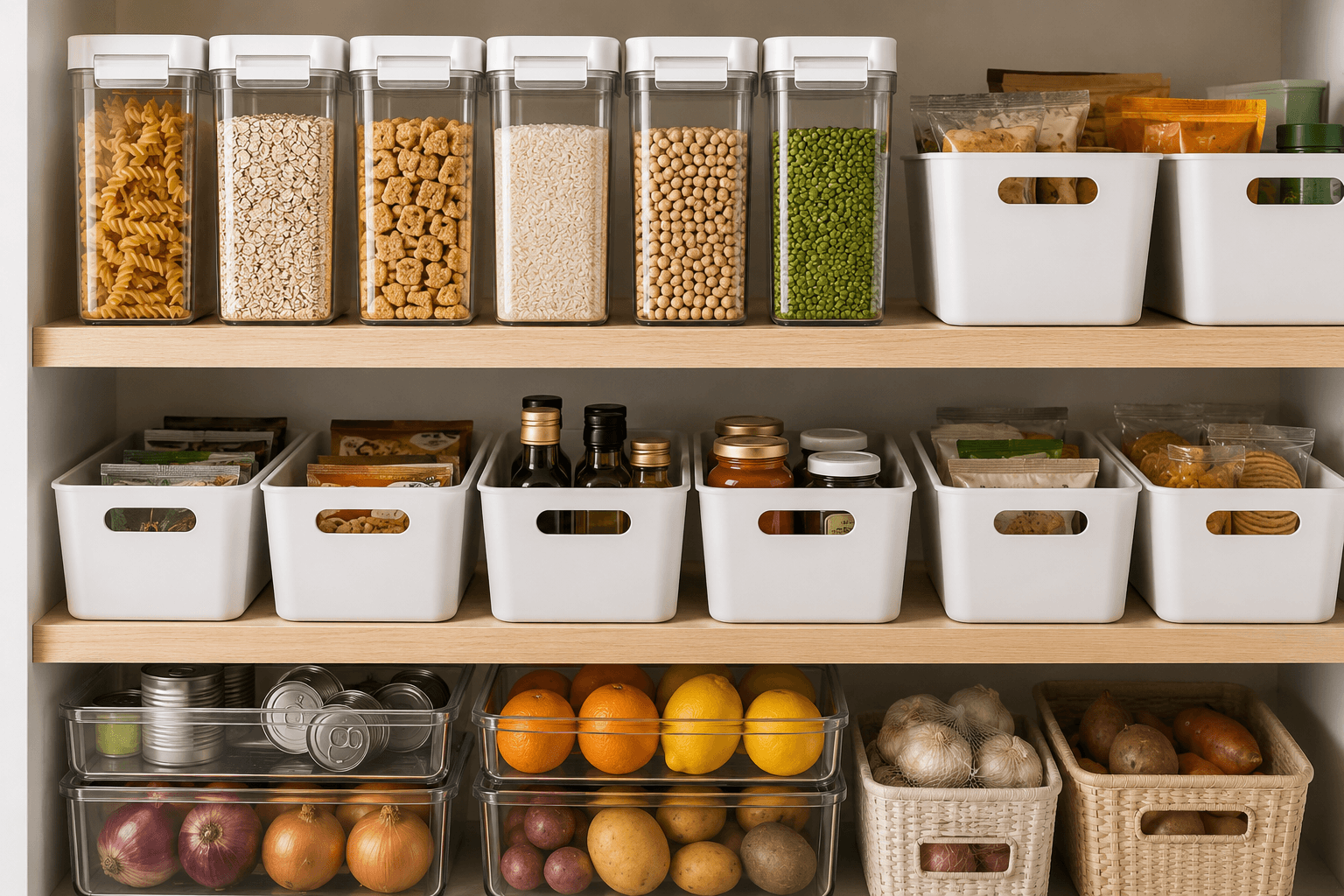
The United Nations Environment Programme estimates that 17% of total global food production is wasted at the household level annually (UNEP Food Waste Index, 2024). A meaningful share of household kitchen waste comes from disorganized pantries — items purchased again because they couldn’t be found, or food that expired unnoticed at the back of a shelf. Clear bins with labels address this directly.
Clear Pantry Bins and Labeled Containers · $15–$45
Best for: Dry goods, snacks, baking supplies, canned good groupings, refrigerator produce zones
Our pick: Vtopmart Clear Bins with Handle 6-pack (~$21) — handles make pantry retrieval easy, BPA-free, consistent sizing.
What to look for: Airtight lids for anything that goes stale; stackable footprint so bins use vertical space; consistent brand so sizes nest and align across shelves
Limitation: Label makers add $15–$30 and a learning curve most people skip. Printed adhesive label sheets ($8–$12) are the lowest-friction option. Buy one sheet before buying a label maker.
Shelf risers and cabinet organizers
The global home storage and organization market was valued at $12.6 billion in 2023 and is projected to grow at 4.8% annually through 2030 (Grand View Research, 2024). Much of that growth is driven by smaller living spaces, where cabinet square footage is fixed and the only available direction is up. Shelf risers solve this without any drilling or renovation.
Shelf Risers and Stackable Cabinet Shelves · $12–$35
Best for: Plates, mugs, canned goods, spice jars, pot lids, mixing bowls
Our pick: SimpleHouseware 2-Tier Expandable Shelf Riser (~$18) — adjustable width, non-slip rubber feet, load-rated for heavier items.
What to look for: Adjustable width that spans the cabinet’s interior fully; non-slip rubber feet; load rating appropriate for your heaviest items
Limitation: Shelf risers don’t work well inside deep cabinets without supplemental lighting — items stored behind the riser become invisible and forgotten within weeks. Pair with a small battery-powered LED tap light if your cabinet is deeper than 40 cm.
Under-sink organizers
According to Houzz’s 2026 Kitchen Trends Study, specialty storage is the top feature homeowners add during kitchen renovations — pull-out trash and recycling bins lead at 64%, followed by tray and cookie sheet drawers at 55%. For renters and anyone not renovating, under-sink organizers replicate much of this functionality without a single hole in the wall.
Under-Sink Organizer Systems · $18–$45
Best for: Cleaning supplies, dish soap, trash bags, sponges, spare dish towels
Our pick: Sevenblue Slide-Out Organizer 2-pack (~$33) — L-shaped design routes around plumbing pipes, 100lb capacity, no tools required.
What to look for: Pull-out or sliding rails that route around plumbing pipes; stackable tiers to maximize vertical depth; open-wire or mesh construction for airflow around cleaning chemicals
Limitation: Under-sink spaces vary dramatically. Drain pipes and garbage disposals can block 30–50% of the cabinet’s depth. Measure your usable width and depth around the existing plumbing before ordering.
Countertop and wall-mounted storage
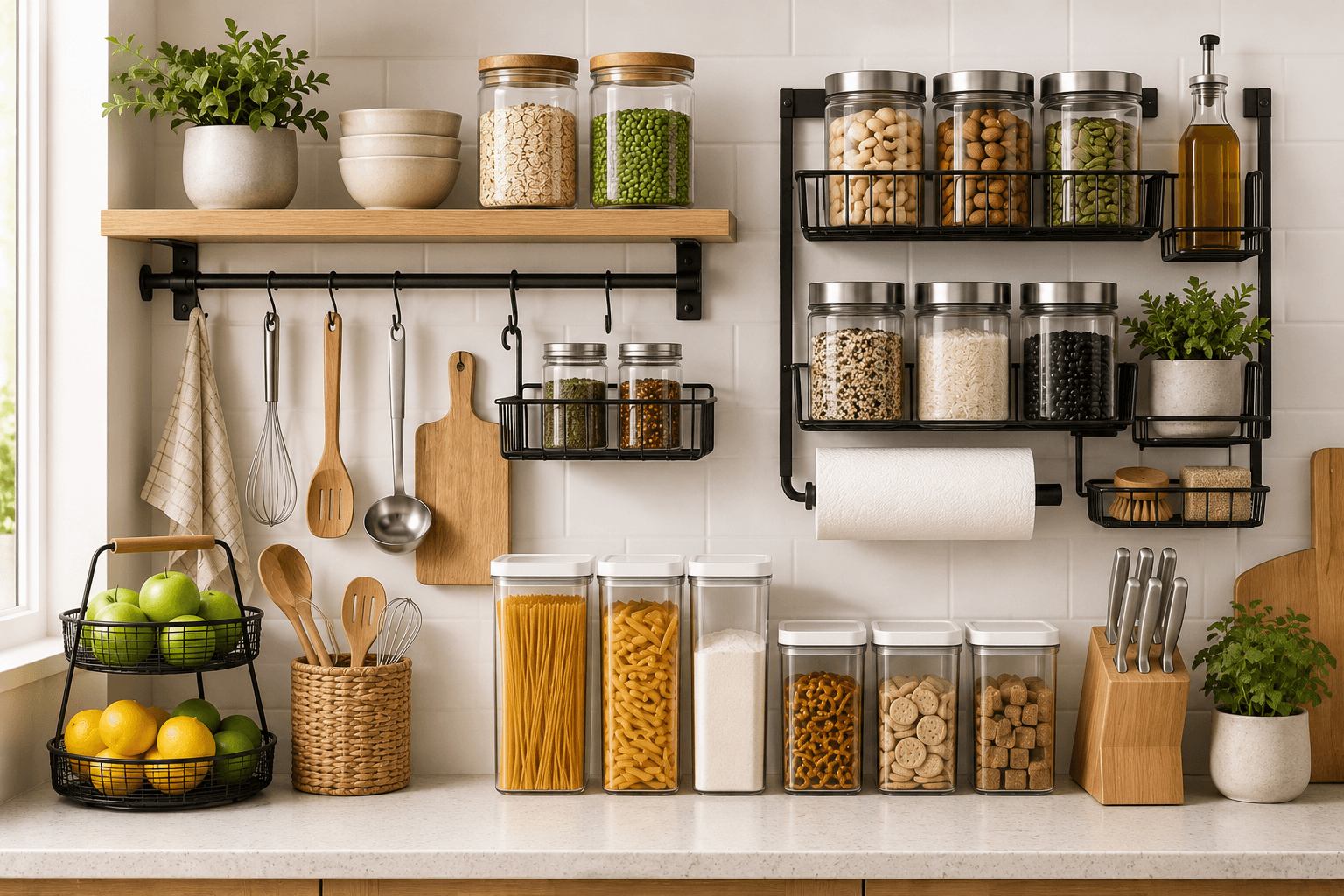
Sixty-two percent of homeowners prioritize clearing countertop clutter (Eagle Woodworking, Jan 2025). A useful rule: a countertop organizer earns its footprint only when it frees up drawer or cabinet space equivalent to at least twice the counter area it occupies.
Countertop and Wall-Mounted Organizers · $12–$40
Best for: Utensil crocks, knife storage, paper towel holders, frequently used tool hooks, over-cabinet-door caddies
Our pick: HOSHANHO 16″ Acacia Wood Magnetic Knife Strip (~$24) — dual-row neodymium magnets, holds 9 knives, adhesive or screw mount.
What to look for: Wall-mounted solutions that shift storage to vertical space above the counter; adhesive hooks rated for at least 2 kg if hanging anything heavier than a dish towel
Limitation: Adhesive hooks fail on textured walls, near stovetop heat, and in high-humidity zones near the sink. For anything load-bearing, use a screw-mounted solution.
Lazy Susans and corner turntables
Corner cabinets and deep shelves are the black holes of kitchen storage — items migrate to the back and are effectively lost until the next deep clean. A Lazy Susan converts dead corner space into fully accessible 360° storage. For upper cabinets and refrigerator shelves, a small two-tier turntable does the same work for spice jars and condiment bottles.
Lazy Susans and Corner Turntables · $10–$30
Best for: Corner cabinets, spice jars in upper cabinets, condiment bottles in refrigerators, cleaning supply storage under sinks
Our pick: LAMU 3-Pack Clear Acrylic Turntable Set (~$20) — three sizes (9.25″, 10.6″, 12″) for the price of one OXO unit.
What to look for: Ball-bearing base that spins smoothly under load; rim height appropriate for your tallest bottles; non-slip base to prevent migration across the shelf
Limitation: Lazy Susans work poorly for irregularly shaped items — bags slide, tall narrow bottles tip during spin. They perform best with uniform-height containers like spice jars, canned goods, and cleaning sprays.
What to buy first
If you’re starting from scratch, the sequence matters more than the individual products. Pick the row that matches your biggest friction point, buy that category first, and stop there until you’ve lived with it for two weeks.
| If your main problem is… | Start with | Budget |
|---|---|---|
| Can’t find utensils quickly | Drawer organizers | $15–$25 |
| Buying food you already own | Clear pantry bins + labels | $25–$40 |
| Cluttered countertop | Wall hooks + utensil crock | $20–$35 |
| Under-sink chaos | Sliding under-sink organizer | $22–$35 |
| Running out of cabinet space | Shelf risers (2-tier) | $12–$22 |
| Corner cabinet dead zone | Lazy Susan turntable set | $14–$25 |
Resist the impulse to buy the entire table at once. Most kitchens are fully functional with three to five targeted purchases made over a month — not a single large order on a Saturday with the energy of a full reset that fades by Wednesday.
“Measure twice, buy once” is the single organizing principle that separates a functional kitchen system from a pile of Amazon returns.
If you’re also thinking about automating parts of your kitchen routine — reminders, smart plugs for appliances, or a robot vacuum for the floor — the smart home devices that solve organization problems guide covers budget-friendly options that pair naturally with a newly organized kitchen.
Frequently Asked Questions
What kitchen organization tool gives the best return for the money?
Drawer organizers consistently deliver the highest return as a first purchase. A $15–$25 set addresses the area where 42% of homeowners report wasting time daily — and unlike most organizers, the benefit is immediate and visible from day one. If you only buy one thing, buy drawer organizers for your utensil drawer.
How do I know what size organizer to buy?
Measure first, always. Measure the interior width, depth, and height of the drawer, cabinet, or shelf — not the exterior cabinet face. Add 1–2 cm of clearance so drawers can open and close without scraping.
Are clear bins worth the extra cost over opaque ones?
For pantry and under-sink storage, yes. Clear bins reduce the need to move items to find what you’re looking for — and it’s that extra step that causes clutter to reform after you’ve organized.
What should I organize first in a cluttered kitchen?
Start with drawers, then the pantry. Drawers contain your most frequently used items — every cooking session touches them — so the daily friction payoff from organizing drawers is immediate.
Do I need to buy everything at once?
No — phased buying typically produces better, longer-lasting results. Start with one drawer or one shelf. Use the system for two weeks, then decide what to add next based on what’s still causing friction.

Mahdy Khairudin
Mahdy writes about budget home organization and smart home automation at Neatara. His approach: research the category, understand the real friction, and find the most proportional solution for a realistic budget.